


Former master’s student Evita van Lingen is investigating whether playful, independent eating reduces mealtime battles during the toddler years.
‘Parents always say you shouldn’t play with your food, but with the Easy Eater you’re actually encouraged to do just that’, says Evita van Lingen. The former master’s student is investigating, during her placement at advisory firm Groente en Meer, whether the Easy Eater – a plate designed to encourage playful, autonomous eating – helps parents through the toddler years. ‘Very little research has been done into tools that promote healthy eating behaviour in children’, Van Lingen writes in her report. ‘The Easy Eater is a coloured plate with coloured compartments and a die bearing the same colours’, she explains. During a meal, the toddler rolls the die and takes a bite from the corresponding compartment. ‘The inventor of the Easy Eater, Menno Kortbeek, is a client of the advisory firm and wanted to know how user-friendly the product is’, says Van Lingen. Does the product make mealtime battles easier for parents, and does it lead toddlers to eat more?
Population
Conducting research for a client took some getting used to at first for Van Lingen. ‘As a scientist, you look at certain things quite differently’, she says. Whereas she would ideally have liked a population drawn from all corners of Europe, Kortbeek was keen to focus primarily on Western European countries. ‘It’s his product, of course, but it was a different way of working’, she continues.
For four weeks, the toddlers eat from the Easy Eater three times a week. Their parents fill in questionnaires, which Van Lingen draws up together with Kortbeek and her supervisor Victoire de Wild. For the study, she enthusiastically approaches parents of young children from five different countries to complete these questionnaires. ‘I think I joined every help, my toddler is a picky eater Facebook group in existence’, Van Lingen laughs. ‘I also spent an entire day cycling around Wageningen putting up posters.’
‘I think I joined every ‘help, my toddler is a picky eater’ Facebook group in existence’
The analysis requires no complex statistics, and the conclusion is clear as far as Van Lingen is concerned: ‘In our participant group, the Easy Eater mostly does what it’s supposed to do’, she says. In short, children eat more readily alongside the rest of the family and there is less conflict at the table. Parents are enthusiastic: nearly 90 per cent continue to use the Easy Eater after the study.
During the toddler years, young children often eat poorly, leading many parents into mealtime battles. ‘As a toddler, you develop a stronger sense of self at that age’, says Van Lingen. ‘They start testing what they can and cannot get away with – including at mealtimes.’ The literature shows that adding a play element to meals and letting children do a great deal themselves leads to children eating more and reduces mealtime conflict. Kortbeek designed the plate on the basis of this gamification and self-determination theory, Van Lingen explains.
Although the Easy Eater generally works well, Van Lingen noticed that the Dutch group of toddlers in particular displayed unruly behaviour. ‘When the die landed on a compartment the toddler didn’t want to eat from, the child would quickly roll again or simply ignore the die’, she says. ‘We didn’t see this in other countries. Perhaps I would have done the same when I was little.’
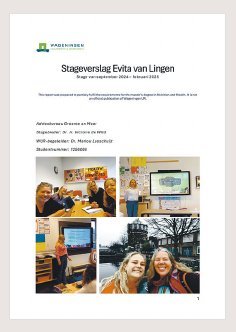
Title: placement study on eating behaviour in children
Author: Evita van Lingen
Category: master’s placement report
Degree programme: Master’s in Nutrition & Health at Wageningen University & Research
Assessors: Victoire de Wild and Marlou Lasschuijt-Schipper
Grade: 8.5
Submit your thesis
Is your master’s thesis, bachelor’s thesis or extended essay interesting reading for your fellow biologists? Send an e-mail to redactie@bionieuws.nl
This article appeared in a themed issue of Bionieuws in collaboration with Jong Leren Eten.

More than 2,300 schools participate in the EU School Fruit Scheme. Children there not only receive free vegetables and fruit, but also receive structured food education. They learn to taste, cook and grow food. At Kindcentrum Bamboe in The Hague, Minister Femke Wiersma visited a tasting lesson and kitchen garden on 15 April: 'One of the best working visits ever'. Habits formed young last a lifetime – in the kitchen too.

In this themed issue of Bionieuws the challenges and solutions surrounding food choices – which are often shaped at a young age – are explored. This issue was produced with financial support from Jong Leren Eten, but was compiled entirely independently by the editorial team.