



More than 2,300 schools participate in the EU School Fruit Scheme. Children there not only receive free vegetables and fruit, but also receive structured food education. They learn to taste, cook and grow food. On 15 April, Minister Femke Wiersma visited a tasting lesson and kitchen garden at Kindcentrum Bamboe in The Hague: ‘One of the best working visits ever’. Good habits start young – in the kitchen too.
This special themed issue of Bionieuws addresses the challenges and solutions surrounding food choices, which are often formed at a young age. This issue was produced with financial support from Jong Leren Eten, but was compiled entirely independently by the editorial team.
 Illustration: Stichting Biowetenschappen en Maatschappij
Why does the number of people with excess weight keep rising, despite decades of prevention policy? In this pre-publication excerpt from the paperback Over gewicht, epidemiologist Jolanda Boer analyses why current policy falls short.
Preventing excess weight is not simply a matter of eating healthily and less, and getting enough exercise. Excess weight is a complex problem in which many factors play a role. Alongside diet and physical activity, stress and sleep are also relevant, as are temptations from the surrounding environment. And once someone has developed obesity, changes occur in the body that make weight loss more difficult, which means that lifestyle adjustments become even harder and are often insufficient on their own. Reducing the number of people with excess weight therefore requires more than simply advising people to eat healthily and exercise enough.
Various international health organisations have issued recommendations for the prevention of excess weight that governments can implement. These go beyond information campaigns to include making the living environment healthier, so that it becomes easier to make healthy choices. What follows is not a comprehensive overview, but a selection of examples of initiatives that the Dutch government implements or financially supports. The Dutch government primarily opts for promoting a healthy lifestyle and making healthy choices more accessible. For instance, the Netherlands Nutrition Centre launched the Healthy School Canteen scheme in 2003. In the Healthy School Canteen, healthy products are abundantly available, making it easier for young people to make healthy choices – often without even realising it. Around 1,200 school sites in secondary and vocational education participate in the Healthy School Canteen scheme. That is 66 per cent of the school sites where young people can buy food and drink. Schools wishing to take a broader approach to nutrition (and physical activity) have been able to do so since 2008 through the Healthy School approach. Schools also pay attention to healthy eating and physical activity in their lessons, and raise the alarm when children are overweight. They also have rules in place – for example, limiting the amount of sweets that can be brought in to share.
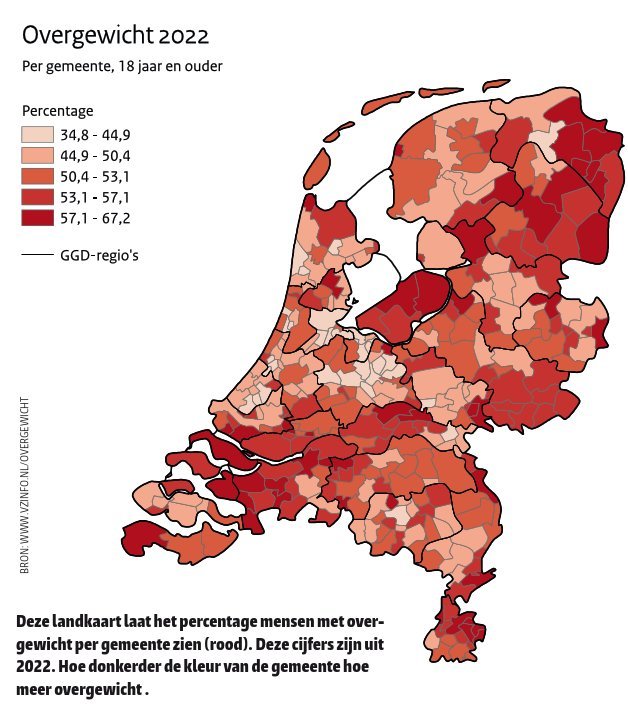
This map shows the percentage of people with excess weight per municipality (in red). These figures are from 2022. The darker the colour of the municipality, the higher the prevalence of excess weight. Source: www.vzinfo.nl
Since 2014, childcare settings have also been able to participate in the Healthy Childcare scheme, enabling young children to grow up in a healthier environment. The government offers support to schools and childcare organisations that wish to take part in these initiatives.
Another important example is the JOGG approach, formerly known as Jongeren Op Gezond Gewicht (Young People at a Healthy Weight). The JOGG foundation helps municipalities to make the places children frequently visit healthier. These include the neighbourhood, school, workplace, sports facilities and other places where they spend their free time. Municipalities do this in collaboration with people working in childcare, education, sport, welfare and healthcare, as well as with entrepreneurs, residents, parents, carers, and children and young people themselves. There are now 230 JOGG municipalities – slightly more than half of all municipalities in the Netherlands.
Cartoon characters
Because the government cannot tackle the problem of excess weight alone, the National Prevention Agreement was concluded in 2018. In it, the government made commitments with more than seventy parties to reduce smoking and alcohol consumption and to address excess weight. These parties include healthcare providers, health insurers, municipalities, sports associations, businesses, educational institutions and civil society organisations. As a result of these commitments, the hospitality industry, catering companies and supermarkets, for example, are also working towards a healthier offering. In addition, food companies and supermarkets have agreed no longer to place characters from cartoons or games aimed at children under the age of 13 on the packaging of unhealthy products.
Vrije Universiteit Amsterdam, together with the organisation Care4Obesity, developed an approach for children with (severe) excess weight (Kind naar Gezonder Gewicht – Child Towards a Healthier Weight). Partners of the Prevention Agreement are rolling out this approach in an increasing number of municipalities. A central care provider coordinates the support of the child and their family. Together they draw up a plan aimed at improving their lifestyle, physical health and quality of life. They also address underlying problems that stand in the way of a healthier lifestyle – such as family difficulties arising from debt or unemployment.
A network-based approach has also been developed for adults, initiated by Partnerschap Overgewicht Nederland (PON) – the Dutch Obesity Partnership – on behalf of the Ministry of Health, Welfare and Sport. This network approach links the medical and social domains, with a central care coordinator at its heart.
Over the past twenty years, the number of people with excess weight in the Netherlands has risen. As a result, the Prevention Agreement’s target – that by 2040 at most 38 per cent of adults and 9.1 per cent of young people will still be overweight – is far from sight. These are the same percentages as in 1995, but back then there were no smartphones or e-bikes, and railway stations had at most a small kiosk. The government has little influence over developments of this kind, yet they do affect the number of people with excess weight.
Screen use
Research by the National Institute for Public Health and the Environment (RIVM) into the possible effects of obesity policy found that experts identified around 130 developments over recent decades that have influenced the proportion of people with excess weight. Nearly two thirds of these contribute to an increase in that proportion. For example, it is now easy to obtain (unhealthy) food anywhere, and often in large portions. The number of people in sedentary jobs has grown, and the rise in screen use also reduces physical activity. The experts believe that without any policy intervention, even more people would have been overweight. But no one knows precisely what the situation would look like had all government initiatives not been implemented.
According to projections, around 56 per cent of adults will be overweight by 2040
What the policy has achieved, at the very least, is greater public awareness of excess weight and its consequences. Initiatives such as JOGG and the Healthy School (Gezonde School) have contributed to this. For instance, calls for fruit and healthy treats in schools are growing louder. Healthcare professionals, including doctors, are also more aware of the importance of a healthy lifestyle. The RIVM research also shows that the number of people with excess weight will continue to rise in the coming years. The agreements within the Prevention Agreement will slow this increase somewhat: according to projections, around 56 per cent of adults will be overweight by 2040, whereas without the agreements the figure would rise to 58 per cent. The proportion of children with excess weight will be approximately 14 per cent rather than 15 per cent.

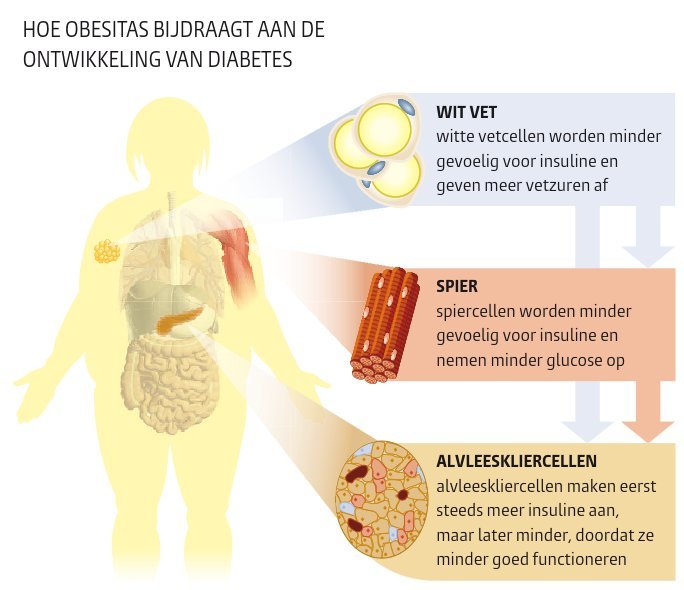
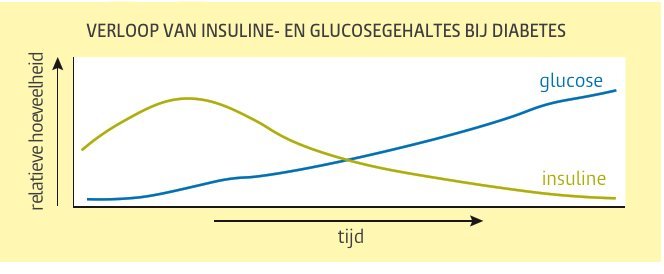 Illustrations: Stichting Biowetenschappen en Maatschappij / Eva Dekker, MSc
These figures make clear that additional measures are needed. The government still makes little use of more stringent policy instruments, such as pricing policy and statutory restrictions, even though such measures are the most effective. Examples include making healthy food cheaper and unhealthy food more expensive, and further restricting advertising for unhealthy food and the locations where (unhealthy) food is sold. Interventions of this kind have consequences not only for health, but also for the economy and for people’s freedom of choice – and that makes the prevention of excess weight even more complex than the many causes of excess weight might already suggest.
Jolanda Boer is a senior epidemiologist and nutritionist at the Centre for Prevention, Lifestyle and Health of the RIVM in Bilthoven
Causes of obesity in children
Childhood obesity is a growing problem for both healthcare and society. The number of children with excess weight and obesity is rising particularly among 12- to 18-year-olds. This increase is driven mainly by changes in our living environment.
Our obesogenic environment is leading to an unhealthier lifestyle in children. Among children aged 4 to 12, approximately 43 per cent exercise for less than one hour per day, according to a health survey by Statistics Netherlands (CBS). Among young people aged 12 to 16, that figure is approximately 66 per cent.
Children of primary school age sit for an average of more than seven hours per day; secondary school pupils sit for an average of nearly ten hours per day. Eating habits are also unhealthy: 75 per cent of children do not meet the recommended daily intake of vegetables – 150 grams per day for primary school pupils, rising to 200 grams for secondary school pupils – or two pieces of fruit.
Fat cells
In addition to lifestyle and environmental factors, other causes can play a role in the development of obesity in children, just as in adults. These include stress, insufficient sleep, and medication that causes weight gain as a side effect. Rarer causes, such as genetic disorders or hypothalamic abnormalities, can also occur in children and are often identified during childhood.
Obesity in children has major societal consequences: damage to health, school dropout and later difficulties in the workplace, and pressure on healthcare services. In the long term, this is unsustainable. To break this cycle, intervention must happen as early as possible – not only once disease has set in. A child with obesity has approximately a 55 per cent chance of still having obesity as a young person (aged 14 to 20), whilst as many as 80 per cent of young people with obesity still have it as adults. This may be related to the fact that the number of fat cells is fixed at a certain point in life. In short: the earlier children with obesity receive treatment, the greater the chance of recovery.
Erica van den Akker is a paediatric endocrinologist and professor of paediatric endocrinology at the Centre for Healthy Weight (Centrum Gezond Gewicht) of Erasmus MC in Rotterdam
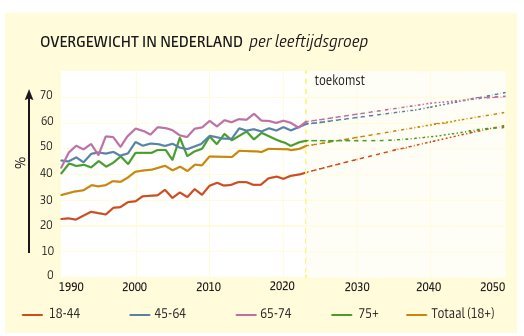
The percentage of Dutch people with excess weight will continue to rise in the coming years, particularly among young people. Illustration: Stichting Biowetenschappen en Maatschappij
New insights into excess weight

OVER GEWICHT – IN EN UIT BALANS
Mariëtte Boon, Raoul Hennekam, Sander Veltkamp, Astrid van de Graaf et al.
Paperback, 142 pages, €15
‘Body fat, once an ally in times of scarcity, has become a problem in a world of abundance. It is no coincidence that obesity – the extreme end of excess weight – is regarded as one of the greatest public health challenges of the 21st century. In the Netherlands, half the population is overweight and one in six struggles with obesity’, writes the Stichting Biowetenschappen en Maatschappij (Foundation for Biosciences and Society) in the invitation for the paperback it is presenting on 21 May at the Rijksmuseum Boerhaave in Leiden. The book brings together expert insights on the complex problem of excess weight and the development of too much body fat. It offers facts and figures, information on the consequences and possible solutions, a number of personal accounts, and interludes on excess weight in animals, fattening agents, and ‘miracle cures’. (GvM)