


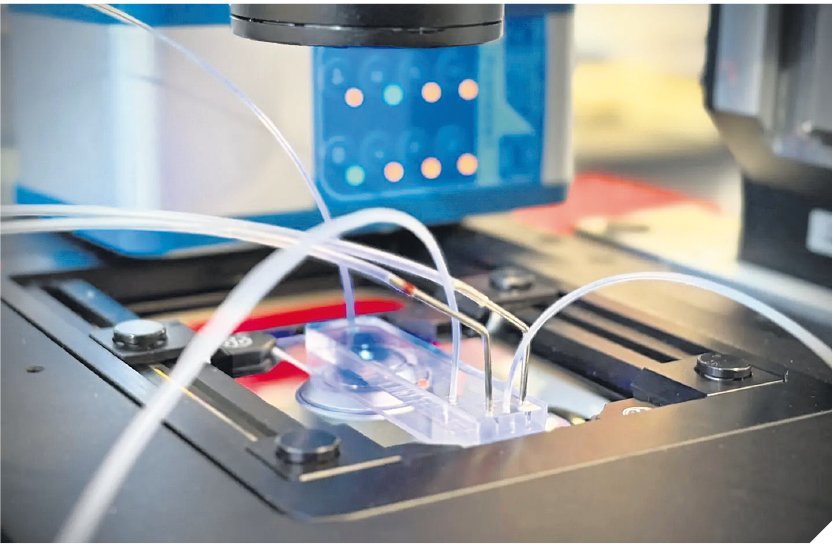
The Sperm Tracking and Recovery (STAR) method of sperm selection has already been named ‘best invention of 2025’ by Time. Photo: Hernant Suryawanshi, Columbia University Fertility Center
A new technique makes it possible to locate and safely isolate rare, living sperm cells in men with severe fertility problems.
Researchers at Columbia University in the United States have developed an innovative method to detect living sperm cells in patients with azoospermia – a condition in which virtually no sperm cells are found in the ejaculate. The technique, called STAR and already named Time‘s ‘best invention of 2025’, combines high-speed imaging, artificial intelligence and microfluidics to detect and isolate rare sperm cells in real time without damaging them (The Lancet, 31 October).
Cell debris
‘The motivation came directly from the clinic’, writes lead author and fertility researcher Hemant Suryawanshi in an email. ‘In azoospermia, finding a few living sperm cells among all the cell debris in the ejaculate is an enormous challenge.’ The condition can be caused by a blockage or a problem with sperm production. ‘Classical methods such as centrifugation are too crude and can damage the cells. We needed a technique that is fast, gentle and label-free – meaning no dyes or antibodies.’
Sperm sample
The STAR technique uses a high-speed camera that captures millions of images per sperm sample. A custom-built AI model analyses each image and attempts to detect living sperm cells. Once found, the cells are progressively isolated using a microfluidic chip with minute channels. A robotic system then removes the sperm cell from the reduced sample. ‘Five years ago, this would not have been possible’, says Suryawanshi. ‘We tested imaging systems costing a few hundred dollars to nearly 30,000 dollars. Thanks to the rapid advances in AI, we were able to continually improve our model.’
STAR could only be developed after the researchers succeeded in designing their own microfluidic chip. ‘Earlier chips could either produce good images or sort efficiently, but not both. Our new chip does both, making it possible to detect and safely collect even individual sperm cells in real time.’
Operational
The first clinical STAR systems are now operational in New York, where they have already been used in more than a hundred patients. In one patient, two living sperm cells were found and isolated on the basis of 2.5 million images. An analysis currently costs around 1,500 dollars per sample. Suryawanshi: ‘We are now working on a more user-friendly version and are exploring other applications where a smart, autonomous technique can make a clinical difference.’