


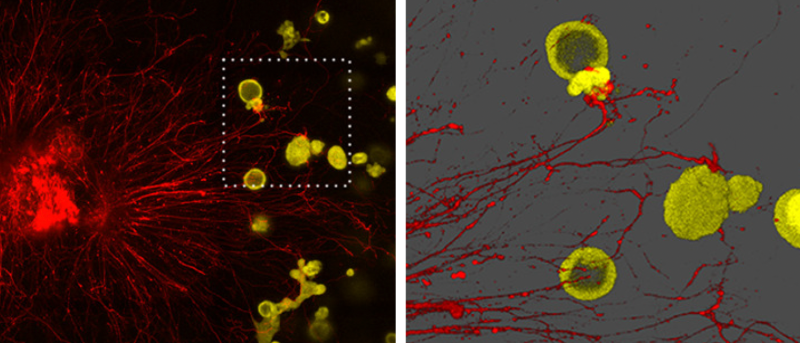
 When sensory neurons (red) are cultured together with gastric cancer organoids (yellow), the neurons and cancer cells form connections resembling synapses and establish an electrical circuit between the cells. Credits: Timothy Wang / Columbia University Vagelos College of Physicians and Surgeons.
Activated neurons cause stomach tumours in mice to grow faster and spread more widely. Migraine medication may be able to prevent this.
Gastric cancer cells form direct connections with sensory neurons. The two cell types communicate via electrical signals. The neural circuit that arises in this way causes tumours to grow more aggressively and metastasise more extensively. That is the conclusion of a team of American, Norwegian and Chinese biomedical researchers writing in Nature on 19 February. That tumours make use of neurons was already known, but such direct communication had until now only been demonstrated in brain tumours.
Stomach tumours attract sensory neurons using the substance NGF (nerve growth factor). The high level of expression of the gene Ngf in tumour cells of mice with gastric cancer points to this, the researchers argue. Moreover, the presence of neurons increases up to thirtyfold in genetically modified mice that overproduce NGF in the gastric epithelium. The neurons involved in turn release the peptide calcitonin gene-related peptide (CGRP), which can influence surrounding cells. That electrical signals arise in both directions is shown by in vitro experiments using a co-culture of neurons and tumour cells. When researchers activate CGRP neurons, they observe an influx of calcium ions into nearby gastric cancer cells, indicating electrical communication. Conversely, optogenetic activation and depolarisation of tumour cells leads to a flow of calcium ions in CGRP neurons. A true synapse, of the kind found between neurons or between nerves and muscle cells, does not appear to be involved, however. The signal transmission is too slow for that.
The neural circuit that apparently forms around stomach tumours is not without consequences. In the co-culture, researchers already observe that activation of neurons promotes tumour growth. The neurons also appear to stimulate tumour cell migration. This is confirmed in mice with gastric cancer in which researchers additionally activate CGRP neurons: these animals develop more liver metastases.
In the co-culture, researchers already observe that activation of neurons promotes tumour growth
CGRP is a well-known target of migraine medications, and this proves useful in mice. In mice with gastric cancer that receive these CGRP blockers, tumour size decreases. These mice also survive longer. ‘Our findings suggest that anti-CGRP drugs represent a promising therapeutic strategy for gastric cancer’, the researchers write in Nature. This may also apply to humans: in previously obtained data from human gastric tumours, the researchers observe a markedly higher density of CGRP neurons than in healthy stomachs.