


Photo: Hans Smid
At the 11th NIBI Conference Language of Life for lower secondary and pre-university education, held on 16 and 17 May, around forty (outdoor) workshops and lectures were scheduled. Bionieuws highlights three sessions that stood out.
Plant communication
Sarah Kalisvaart and Zoë Delamore, PhD candidates at the Laboratory of Entomology at Wageningen University
‘Our starting point was simple: to show teachers and pupils that plants communicate through scents – and to let them experience it for themselves. We developed that idea into a practical that is easy to carry out in the classroom. All you need is a few types of vegetable – such as cabbage, spinach and pepper – and caterpillars of the large white, which you can easily order with care instructions from the Dutch Butterfly Conservation organisation. ‘In the first experiments, pupils place two different vegetables in a Petri dish. They can choose whether to use two green vegetables, such as spinach and cabbage, or vegetables that contrast in colour, for example red pepper and green cabbage. They then place a caterpillar in the middle and observe which it chooses. Regardless of the colour of the other vegetable, the caterpillar always chooses cabbage – the host plant on which large whites lay their eggs in the wild. They are blind, so they rely entirely on scent.
‘As a finale, pupils do a scent test’
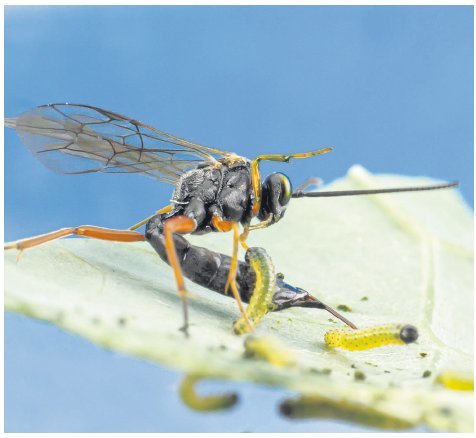
‘Next comes the ecological context: why does the plant produce that scent? Not to attract caterpillars, but to defend itself. The scent attracts parasitic wasps, which lay their eggs inside the caterpillars. We use short films to show how this works. ‘As a finale, pupils do a scent test: blindfolded, they try to identify vegetables by their scent. First as normal, then bruised. Bruising releases the volatile compounds more readily – which simulates, in effect, the feeding damage caused by a caterpillar.
‘We are PhD candidates, not teachers, so it was valuable to hear that this practical fits well with what teachers already do. They appreciated that we placed it in an ecological context. The full protocol will be published on the NIBI website. We don’t yet have a worksheet, but everything you need is included: materials, step-by-step instructions, films and background information.’

Scientific vocabulary
Jeff Gradener and Gerald van Dijk, both biology teacher educators at the Archimedes Institute of the University of Applied Sciences Utrecht
‘Biology is a subject full of language. Pupils often have to switch within a single text between levels of organisation, processes, functions and structures. That is demanding. It is therefore important for pupils that biology teachers pay attention to language. It supports the development of understanding.
‘During the NIBI workshop, we showed participants a transcript of a teacher explaining something. We then asked something along the lines of: “What would your mother make of this?” The answer was almost always: virtually nothing. That gets people thinking, because they realise that they themselves sometimes give explanations that are peppered with technical jargon.
‘We then got to work together, drawing on that insight among other things. In pairs, teachers looked at lesson materials they had brought themselves and analysed them: what are the key concepts? Which are abstract, which are everyday? How can you first let pupils understand the story in plain, everyday language before switching to academic language? Because that step is usually taken far too quickly. Let pupils talk to each other about the subject matter, connect it to their own world, and help them make links between concepts.
‘We also see in the draft final examination syllabuses that language is playing an increasingly central role. Pupils must be able to formulate a reasoned position with linguistic support. That calls for conscious attention to language in our lessons. We are ourselves experienced teachers – including in lower secondary vocational education – and we know how full the timetable can be, but this need not cost any extra lesson time. Many biology teachers already work in a language-focused way, often without realising it. With a little help, you can approach this more systematically: the SLO website contains a great deal of material, and the Handbook of Language-Focused Subject Teaching by Maaike Hajer is really essential reading.’
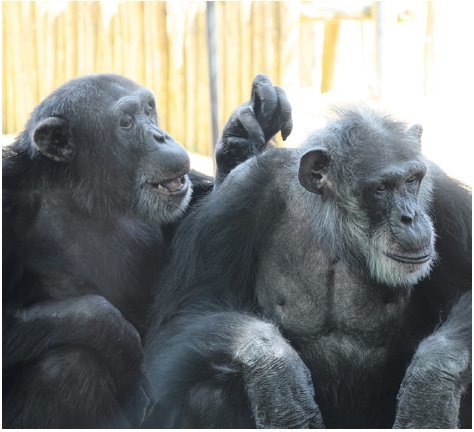
Photo: Daniël Seesink
Great ape behaviour
Daniël Seesink, former biology teacher and organisational primatologist at Bewust Zoo
‘What I always try to convey to teachers during my lectures or workshops is that we should actually do more “grooming” in the classroom. Just like apes. Through grooming, they invest in one another, build trust, and can rely on each other when things get tense. In education, we are often too quick to focus on curriculum pressure, grades and tests. But the golden weeks – those first weeks of the school year – are crucial for building relationships, both among pupils and between pupils and their teacher.
‘So don’t focus solely on what pupils need to achieve; also establish a shared goal together: how do we want to function as a class this year? What do we want to accomplish together? That is far more powerful than simply working through a textbook. It starts with listening, being non-judgmental, and getting to know one another. Although this takes a great deal of time, it reduces the likelihood of running into problems later on. It helps if you, as a teacher, lead by example and show that you can collaborate and are willing to adapt.
‘Ask yourself: who can help me bring the class along?’
‘Ultimately, it comes down to whether you want to be the boss or a leader, whether you opt for control or for collaboration. I always recommend giving pupils responsibilities wherever possible. You can, for instance, deploy them as mediators in conflicts between classmates, thereby giving them a role in the group dynamics. Ask yourself: who can help me bring the class along? Because if you impose something, it often backfires.
‘A leader in a group of apes knows that he cannot manage alone. He seeks support from others in the group, makes connections, and plays politics. In that respect, apes are a fine example for teachers.’