


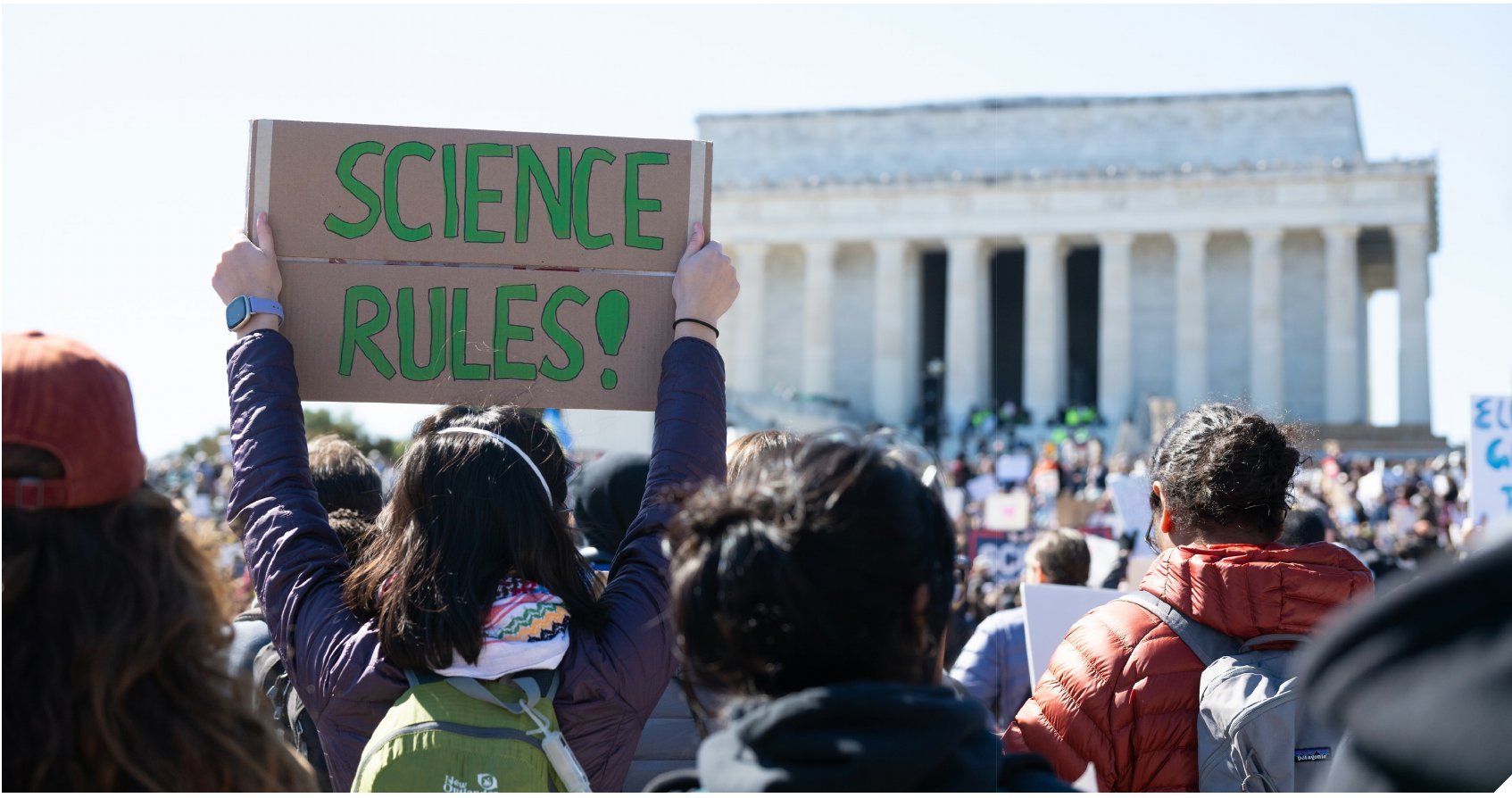
‘The Trump administration is carrying out a fierce assault on science’, according to science programme Focus. What are Dutch researchers making of it?
Science in America has been thrown into turmoil since President Donald Trump took office. Grants are no longer awarded if the application contains words such as woman, diversity or climate change. Calling colleagues abroad is prohibited. What are Dutch researchers feeling about this? – that was the question science programme Focus asked on 12 March. Bionieuws has compiled the responses of life scientists who were interviewed.
‘It is almost incomprehensible at what speed science is being dismantled here – it is deeply alarming. The world is highly interconnected when it comes to science, and the US plays a crucial role in that. This has an enormous impact, not only on the Netherlands, but globally too. And also for the democratic rule of law. Open, uncensored science is an important part of that. If it can erode so rapidly in America, what does that mean for the Netherlands in the long term? America was a beacon of excellent and free science. That has come under such pressure in no time at all.
‘We ourselves also collect enormous amounts of data. We usually share that data. We need to take more control ourselves over the medium on which it is stored, so that we are not dependent on big tech in America. But we have been making the case for greater investment in this in Europe for a very long time. I am very glad that the minister – the Minister of Education, Culture and Science, Eppo Bruins – says he will continue to stand up for academic freedom and integrity, and I sincerely hope those are not empty words. And that he will keep explaining to his colleagues that dissenting voices, facts, and critical reflection on the world around us – in whatever field – are necessary in order to make progress and to prevent us from being hijacked by other interests. That also means that politicians do not interfere in substantive choices in science and education. Funding is an important part of that.’
‘In the long term, it is life-threatening if you stop researching climate change and stop trying to address it. Moreover, when extreme weather events occur, life-threatening situations can arise if the capacity to predict them is reduced and you cannot warn people in time.
‘I am afraid that we will all be forced to conduct research within our own geographical area. But science thrives on criticism from others, and the further away those people are from you, the better placed they are to offer that criticism.
‘A great many people take part in an IPCC assessment. A third of them are now simply being removed. Whether you like it or not, that will ultimately affect the quality of the reports.
‘The moment gaps appear in data collection in America, Americans will be the first to suffer, but we will be indirectly affected too. For climate research you really need long measurement series – on the order of thirty or fifty years. If you remove periods from those series, they become far less reliable. You can then no longer determine whether the Atlantic overturning circulation is going to change.’

‘It is an enormous attack on what my research is about. With a single stroke of the pen it is being undone and classified as something that does not exist. I am organising a workshop on sex differences in cardiovascular disease. We had planned to focus both on biological differences and on societal, socially driven differences, which also help explain why men and women use healthcare differently. We are now seeing American colleagues say: we can really only talk about biological differences any more. Words like women and female – they are not allowed to use them. But also words that have nothing to do with diversity and inclusion at all, such as bias or increase. ‘I recently submitted a grant application with a large international consortium in which America plays a major role. We now do not know whether our American colleagues will be able to continue participating. I have chosen not to go along with the censorship. If American colleagues cannot take part, that is deeply regrettable, but we must not allow US policy to reshape our research practices.’
‘Their withdrawal from the WHO is an extremely worrying measure. Not least because America accounts for a fifth of the budget, with the portion earmarked for disasters, outbreaks and other crises being hit hardest. Colleagues at the WHO say they are being forced to make impossible choices: do we tackle polio in Central Africa, or do we respond to an Ebola outbreak? On top of that, the US is withdrawing from agreed commitments. Outbreaks must be reported to the WHO so that everyone is on alert. The avian influenza outbreak in America could be followed closely until early January, and then the website suddenly went offline. If you can no longer monitor such outbreaks closely enough to respond to them: that is life-threatening.
‘Science is falling behind. We are already feeling the effects of that. A great many researchers depend on NIH funding. Groups around the world work together. Research into medicines and vaccines has stalled, or is being delayed because information can no longer be exchanged. They can no longer attend conferences and are only permitted to publish if research has very high impact. The time it will take to catch up again… There is also a significant loss of knowledge as scientists are dismissed.
‘Scientists there feel a duty to win back trust. That is also one of the lessons of the pandemic. That we as scientists need to do a better job of conveying how science works, and that with today’s knowledge you can look differently at the conclusions of yesterday.’