


They are not exactly pleasant to smell, but for sixth-form student Isabella Urbanus it was nonetheless a wonderful experience to rear the caterpillars of the large white at home and watch them develop.
‘It wasn’t really a pleasant smell. They produced quite a lot of droppings, and the cabbage they fed on didn’t smell great either. You did get used to it eventually, but honestly… it just stank enormously, of sulfur’, recalls former sixth-form student Isabella Urbanus of the Thomas à Kempis College in Arnhem. In her extended project she thanks her parents and brother explicitly ‘for putting up with the smelly caterpillars in their rooms’. The suffering ultimately pays off: she receives a 9.2 and second place in the KNAW Education Prize 2024 in the Nature & Health category.
The caterpillars in question belong to the large white, Pieris brassicae. Adult butterflies are thrown into confusion by rising temperatures in the Netherlands and, during heatwaves, struggle to judge when to enter or emerge from hibernation, Urbanus explains. ‘I wanted to find out whether temperature also affects the growth and development of the caterpillars.’ To that end, she contacts the Dutch Butterfly Conservation (Vlinderstichting), where she collects hundreds of newly hatched caterpillars for her home-based research.
Mesh
‘There were far too many, of course, so I released most of them straight away. For the sixty that remained I set up six rearing boxes in which they could continue to develop. Over each one I placed a box fitted with a lamp, so that they all had light 24 hours a day and that abiotic factor remained constant. Because the caterpillars were so tiny at first, I had to use several layers of mesh to prevent them from escaping through the ventilation holes in the rearing boxes.’ All the caterpillars were then given an abundance of food: organic pointed cabbage from the supermarket.
The six caterpillar enclosures are each assigned their own spot in and around Urbanus’s home: the shed, the cellar, the attic, the living room, her own bedroom, and her brother’s bedroom. ‘Each location had a different average temperature. It fluctuated a little, of course, but not much. After that it was a matter of measuring every day: the weight and length of the caterpillars, the humidity, and the temperature. I did that every day in the morning, just after school, and just before I went to bed.’
Once the caterpillars begin to pupate, Urbanus leaves them in peace. ‘They stop crawling around and start moving their heads back and forth. Red droppings also turned out to be a sign of pupation. Fortunately, because the first time I saw that I was absolutely horrified – I thought they were ill. A few did rot during pupation, which made them smell even worse. That took some perseverance from everyone’, she says.
It ultimately emerges that at higher temperatures the growth in length and weight of Pieris brassicae increases more rapidly. The caterpillars also pupate earlier and emerge more quickly. ‘This may be due to faster enzymatic processes at higher temperatures’, speculates Urbanus, now a first-year biomedical sciences student in Utrecht. ‘It was extraordinary to watch a caterpillar develop into a butterfly. When I finally released them as butterflies through the window, that was a special moment too. They had become a little bit my babies.’
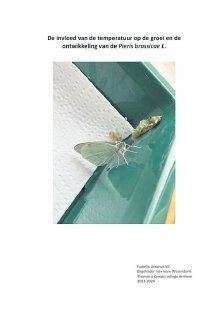
Title: The influence of temperature on the growth and development of Pieris brassicae L.
Author: Isabella Urbanus
Category: extended project
Education: pre-university secondary education (vwo) at the Thomas à Kempis College in Arnhem
Assessor: Leonie Wezendonk
Grade: 9.2
Special distinction: second place, KNAW Education Prize 2024
Submit your thesis
Is your master’s dissertation, bachelor’s thesis or extended project interesting reading for your fellow biologists? Send an e-mail to redactie@bionieuws.nl