


Three sixth-form students investigate the declining vaccination rate and encounter misinformation, language barriers, and inadequate public health communication.
Anyone searching online for the dangers of the MMR vaccine will fairly easily land on websites linking the jab to autism. This has long been thoroughly debunked by science, but the average parent searching the internet is unlikely to know that. Reliable information is often harder to find – as three upper sixth-form students at the Rijnlands Lyceum Sassenheim have discovered. For their extended research project, they spent months investigating why fewer and fewer parents are having their children vaccinated against mumps, measles, and rubella. ‘It was quite a shock’, says Puck Ruigrok. ‘We had to click at least five times to find accurate, reliable information, and even then the explanation was fairly complicated. Whereas misinformation is more or less lying around on the internet for anyone to pick up.’ Together with classmates Robyn Sturkenboom and Doortje Warmerdam, she investigated the causes and consequences of the declining vaccination rate. The trio delved into the scientific literature, interviewed parents and healthcare professionals, and visualised the relationship between vaccination rate and infection risk. On 26 June they won the KNAW Education Prize in the Nature and Health category.
Highly technical
‘I thought: I’ll get that literature review done in a week, but it ended up taking well over a month’, says Sturkenboom. ‘I worked through epidemiological publications, combined formulae, produced graphs – I massively underestimated it. The papers were highly technical, and I wanted to do it perfectly.’ She found a clear relationship between vaccination rate and infection risk. ‘Around 95 per cent you’re in good shape – that is also the RIVM standard. But in some regions, such as parts of the Bible Belt, we’re at 60 per cent. Those are real hotspots, with a heightened risk of outbreaks.’ Yet there turns out to be no single clear-cut figure for what constitutes a dangerous level of declining vaccination coverage, Sturkenboom explains. ‘Since the introduction of the new privacy legislation, vaccination data have become less detailed, meaning information on age and background, for example, is often missing. The extent of natural immunity is also poorly understood, and it varies by disease and by generation. All of these factors make it harder to assess the risks.’
Vaccine refusal
Alongside gathering scientific literature, the students conducted interviews with parents. ‘That was my task’, says Ruigrok. ‘But that also turned out to be difficult. Parents who had chosen not to vaccinate their children were particularly reluctant to take part.’ In the end she only interviewed parents whose children had been vaccinated, but to reconstruct the opposing view she also spoke with healthcare professionals. They cited a range of reasons for vaccine refusal: from religious conviction and language barriers to simple complacency. ‘The first jab is administered through the child health clinic, so parents don’t have to make any extra effort. But for the second vaccination they have to travel to a vaccination centre themselves – and that turns out to be a barrier.’
Free of charge
A significant problem, the students – who have since passed their final exams – emphasise, is misinformation. They therefore recommend that organisations such as the GGD and RIVM become more visible on social media and provide clear, straightforward information in multiple languages. Practical solutions can also help. ‘Bring the vaccinations to the people’, Ruigrok proposes. ‘Go to schools or community centres. That removes the logistical barrier. The National Immunisation Programme offers vaccinations free of charge, and it is a shame that this is not always taken advantage of.’
The extended research project runs to no fewer than seventy thousand words – well above the limit. ‘We wanted to do it so well. In hindsight, perhaps a little too ambitious’, says Sturkenboom. ‘But we are all three very proud of the result, and glad that our work has received so much attention.’
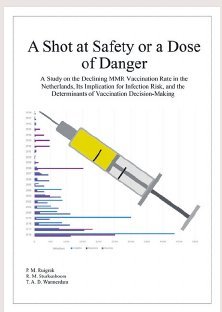
Title: A Shot at Safety or a Dose of Danger
Authors: Puck Ruigrok, Robyn Sturkenboom and Doortje Warmerdam
Category: extended research project
Programme: pre-university education (vwo) at the Rijnlands Lyceum Sassenheim
Assessor: Bastiaan Kikkert
Grade: 9.7
Special distinction: winner of the KNAW Education Prize
Submit your thesis
Is your master’s dissertation, bachelor’s thesis, or extended research project of interest to your fellow biologists? Send an e-mail to redactie@bionieuws.nl