


The excavations at Trinil in November 1900. PHOTO: DUBO1494, DUBOIS COLLECTION NATURALIS
For the first time, a large natural history collection is being returned to a former colony. What considerations surround the Dubois collection, and what does this mean for other collections?
‘What has surprised me most is the scale. I had expected that key pieces such as the skullcap, femur and molar of Homo erectus would be returned to Indonesia. Or perhaps everything Dubois excavated at Trinil. But the complete natural history collection? That does shock me, and I find it unsettling, because this sets a precedent. What does it mean for the tens of thousands of insects once collected in Indonesia, for the material from the Siboga expedition, and for the Naturalis herbarium, which is full of material from Asia, South America and Africa? You are opening a kind of Pandora’s box’, says palaeobiologist Jelle Reumer, emeritus professor of vertebrate palaeontology at Utrecht and former director of the Natural History Museum Rotterdam. This is in response to the announcement of 26 September that the Netherlands is returning more than 28,000 artefacts from the Dubois collection at Naturalis to Indonesia (Bionieuws, 3 October).
A world first
The return of looted colonial art or cultural heritage feels different from the return of fossils or other natural history objects, which have no obvious owner and seem more like natural heritage or world heritage. The ‘unconditional return’ of a large natural history collection to a former colony is a world first. There are still three repatriation requests pending at the Natural History Museum in London (Science, 2019): from Chile (remains of the ground sloth Mylodon darwinii), Zambia (the Broken Hill skull of Homo heidelbergensis) and Gibraltar (two Neanderthal skulls), but little progress is being made on any of them. Although the chair of the advisory committee on colonial collections, Lilian Gonçalves-Ho Kang You, explicitly states that their advice ‘concerns only the Dubois collection’, the committee’s considerations and other cases are certainly instructive (see sidebars).
The excavations thus took place ‘in the context of a colonial system founded on violence’
The Dubois collection originates from a country over which the Netherlands exercised colonial authority at the time: Indonesia (formerly the Dutch East Indies). From 1889, Dubois was employed there by the colonial Department of Education, Worship and Industry to lead fossil-hunting expeditions. He was assigned two officers of the Royal Netherlands East Indies Army as assistants and made use of local labourers and forced labourers. At the site where the most important finds were made – the locality of Trinil in a bend of the Solo River (photo above) – the report records ‘thirty to forty prisoners’ who were put to work under ‘extremely harsh conditions’. There is also evidence of theft of fossils, refusal by the local population to reveal the locations of sites, excavations carried out in part on land to which the local population also had claims, and no indication that any compensation was paid. The excavations thus took place ‘in the context of a colonial system founded on violence, exploitation and unequal power relations’. These are all arguments that, in the committee’s view, make it plausible that the fossils ‘were taken against the will of the population’, who were thereby ‘wronged’.
Transfer of ownership
In its conclusion, the committee lists that judgement only as its second finding. The first is that it is ‘plausible that the Dubois collection never became the property of the Dutch state’. This is based on a complex legal dossier that essentially comes down to the fact that Dubois was employed by a colonial administration that operated separately from the mother country. He was granted permission by this administration to take the fossils to the Netherlands for identification and description. Only after that was ownership to be transferred to the Dutch government – probably in part to encourage him to complete the work promptly. Because Dubois died in 1940 ‘without having completed the processing of the collection’, no transfer of ownership ever took place. From 1940 onwards, the Netherlands was therefore formally ‘the custodian of the collection on behalf of the Netherlands Indies government’. This claim lapsed thirty years later, but that does not make the custodian the new owner, even though the original owner can no longer enforce their claim either. A legal impasse that is now being broken by returning the collection to Indonesia, including its metadata, ‘in the context of redressing historical injustice’. The historians Caroline Drieënhuizen (Open University of the Netherlands) and Fenneke Sysling (Leiden University), whose publications and opinion pieces helped drive the restitution campaign (see Bionieuws 3, 2023), note with satisfaction that their efforts have had an impact. ‘We can see that the injustice of involuntary loss of possession is the key argument in the advice’, says Sysling, ‘but we feel that the argument of the great cultural significance for Indonesia has been somewhat overshadowed.’ ‘Scientists must realise that natural history objects, once collected, also become objects of cultural history’, argues Drieënhuizen. In their view, this means above all that natural scientists must always engage with the debate about the provenance and significance of their collections.
Errors
Dubois expert and Naturalis guest researcher Paul Albers has identified several troubling errors in the committee’s report, but welcomes the restitution in principle. ‘Primarily because the lack of access to collections has been detrimental to the development of science in Indonesia. When young scientists in former colonies want to protect their biodiversity in the future, they will need comparative material – and that material is currently held largely in storerooms in Leiden, but also in London, Paris, Frankfurt and Berlin. I suggested to the committee that such collections be left on loan where they are for the time being, with a hundred years allowed for the transfer. Because simply moving things around doesn’t really get anyone anywhere’, says Albers. ‘It is an illusion to think that doing so reverses all the consequences of colonialism.’
Holotype mosasaur in Paris
The type specimen of Mosasaurus hoffmanni now sits unclaimed in the Muséum National d’Histoire Naturelle in Paris. The fossil, with its two spectacular jaws (photo), comes from the limestone of the Sint-Pietersberg near Maastricht. After its discovery in 1778, it ended up in the natural history cabinet of the Chapter of Saint Servatius. It was initially thought to be a crocodile. It became such an iconic fossil because many famous scholars speculated about the nature of the extinct animal: the Groningen zoologist Petrus Camper identified it as a toothed whale, whilst the French anatomist Georges Cuvier recognised it as a (lizard-like marine) reptile. The reason Cuvier was able to study the famous fossil is that French troops took it from Maastricht in 1794 as war booty and a trophy. It has since been declared part of France’s national heritage, and in 2009 the Grand Animal de Maestricht was briefly allowed to return – under strict guarantees of its return – to its place of discovery for a temporary exhibition. At the end of 2023, the municipality of Maastricht sent the French an official request for restitution, via the Dutch cabinet. For a long time there was no response, but last February Alderman Bastiaens announced that the fossil would be coming to the Natural History Museum Maastricht on ‘long-term loan’ in 2026. The mosasaur will be joined there by its relatives Bèr, Lars, George, Pieter and Sjors – but for how long?
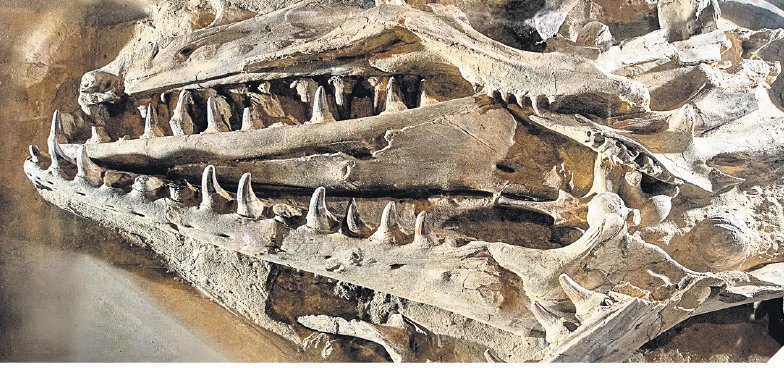
Mosasaurus hoffmanni fossil at the Muséum National d’Histoire Naturelle in Paris. Photo: Agnes Iatzoura, MNHN
Urk skulls in Utrecht
Until 2010, Utrecht University Museum held a collection of six skulls from Urk, originating from a churchyard on the island. The professor of biology Pieter Harting of Utrecht University took cranial measurements of three of them in order to identify ‘unadulterated’ characteristics of the early inhabitants of the Netherlands, concluding in 1853 on this basis that the island’s inhabitants were probably not of Celtic origin. A general practitioner from Hilversum supplied Harting with three more Urk skulls, which he had stolen from the Urk churchyard by secretly swapping them for skulls he had brought with him. In 2006, a story about the stolen skulls appeared in the booklet Zoutzoet, about the reclamation of Urk from the sea. A year later, this led to a visit by a delegation from Urk (photo) and the establishment of the Comité Urker Schedels (Committee for the Urk Skulls), which submitted an official request for restitution in 2008. The Utrecht museum was initially reluctant to comply, citing the collection’s importance to the history of science. But when the Ethics Committee of the Dutch Museums Association recommended transferring the skulls, the university made precise casts and handed over the six originals. On 20 July 2010, these were interred in a private ceremony at the Kerkje aan de Zee, overlooking the Urk Fishermen’s Monument and the IJsselmeer.
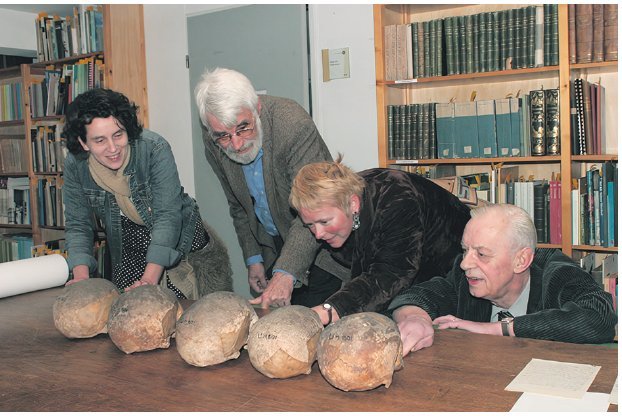
A delegation from Urk examining the skulls at Utrecht University Museum in 2007. Photo: Comité Urker Schedels
Long-necked dinosaurs in Berlin
For nearly ninety years it has been the star attraction of Berlin’s Museum für Naturkunde (MfN): the skeleton of ‘Oskar’, the sauropod Giraffatitan (formerly: Brachiosaurus) brancai, displayed in the central courtyard (photo). At thirteen metres tall, the skeleton holds a world record – but it also carries a colonial past: it comes from the German Tendaguru expedition, which from 1909 to 1913 exploited a rich deposit of Jurassic fossils in southern Tanzania, then part of the German colony of Deutsch-Ostafrika. Under the direction of German expedition leaders, local workers excavated 230 tonnes of dinosaur bones, including several complete long-necked dinosaurs. Around ten years ago, debate arose as to whether these fossils should be returned to Africa, although the Tanzanian government itself judged this to be ‘unrealistic’. At the museum, this prompted self-reflection, research into the colonial context of the collection, and in 2015 the establishment of the Research and Responsibility project. This project aims to make the Tendaguru fossils and all archived documentation digitally available worldwide for research in the natural and social sciences. The museum also supports the management of and research into collections in former colonies through travel grants, meetings and training. The MfN additionally took the initiative to establish TheMuseumsLab.org, a platform that since 2021 has been promoting structural change in African–European relations within the museum sector.
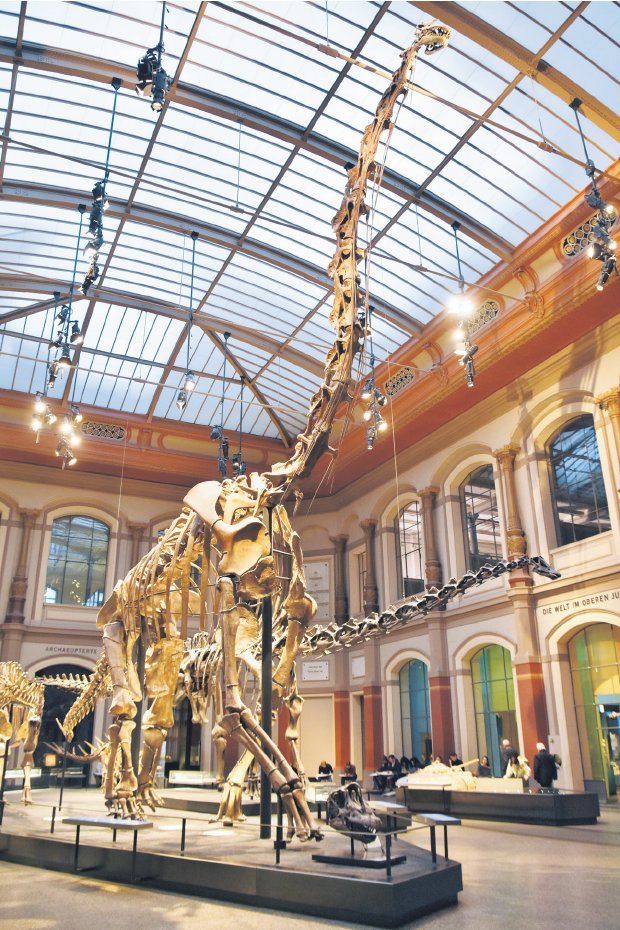
Skeleton of Giraffatitan at the Museum für Naturkunde in Berlin. Photo: Richard Mortel