


From 2023 to 2025, the Dutch sailing vessel the Oosterschelde is completing the Darwin200 Global Voyage in 32 legs, taking stock of the state of nature and the environment worldwide – nearly two centuries after Darwin’s own voyage around the world.
1836
‘After a comparatively short passage, but with very heavy weather, we came to anchor at Falmouth. To my surprise and shame I confess that the first sight of the English coast made me no warmer than if it had been a miserable Portuguese settlement’, writes Darwin, who set foot ashore in Cornwall on the ‘terribly stormy night’ of 2 October 1836. In nearly five years (1,790 days) he had covered some 80,000 kilometres, visited six continents, and collected around 1,400 plants and 500 birds along the way. His arrival in Falmouth (vividly depicted in 2009 by John Dyer, see image) is commemorated only by a modest plaque on Market Street–Fish Strand Hill, from where he almost immediately boarded the mail coach to his birthplace Shrewsbury. He arrived there on 4 October quite late in the evening and spent the night – very British of him – at Lions Inn, so as not to disturb his family. He surprised his father and sisters at The Mount House the following morning at breakfast, and the dog greeted him as though he had never been away. In the 46 years of life that remained to Darwin, he would never again travel abroad.
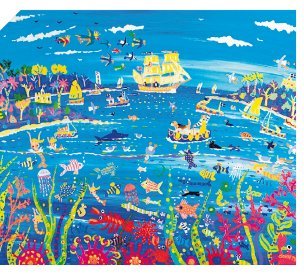
Depiction of the arrival of the Beagle in Falmouth, by John Dyer, Darwin200 artist in residence in 2009. Credits: John Dyer.
The Oosterschelde arrives in Falmouth on 19 July and from 18:00 celebrates a Global Voyage Homecoming Party at the National Maritime Museum Cornwall. The sailing vessel has also covered approximately 80,000 kilometres over two years, and departs the following day for a fully booked Victory Lap to London. It anchors there on 27 July at Greenwich – the cradle of British seafaring and the boundary between the western and eastern hemispheres – with views of the tea clipper Cutty Sark (completed in 1869) and the Royal Observatory (founded in 1675)1. Here, since 1833 and to this day – precisely at 13:00 – the red ball rises to the top of the mast to allow ships to synchronise their chronometers.
The Darwin200 project concludes this summer with a closing awards ceremony in honour of the Darwin Leaders trained during the voyage, and a lecture on the origin of life on Earth. Dutch fans of the Oosterschelde can welcome the three-masted topsail schooner back on 1 August in her home port of Rotterdam – or during the spectacular 10th edition of Sail Amsterdam, the largest free public event in the Netherlands, which this year celebrates both its 50th anniversary and the 750th birthday of our capital city.
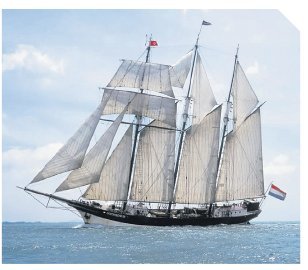
The Oosterschelde is the last surviving original Dutch three-master (built 1917, restored 1992).
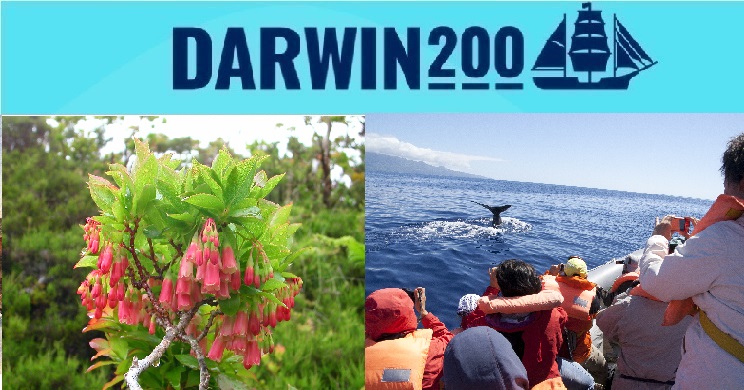
From 2023 to 2025, the Dutch sailing vessel the Oosterschelde is voyaging the Darwin200 Global Voyage in 32 legs to take stock of the state of nature and the environment worldwide, nearly two centuries after Darwin’s own circumnavigation.
To the great frustration of the homesick crew, Captain FitzRoy set course on 23 July 1836 for Salvador da Bahia on the Brazilian side of the Atlantic Ocean, to spend another month carrying out hydrographic surveys. The Beagle then headed northwards, crossed the equator on 21 August, and made a four-day stopover on the Cape Verde island of Santiago, which they had also visited just over four years earlier (see leg 2). The final stopover, lasting five days, was on the island of Terceira in the Azores. Darwin was evidently thoroughly worn out by this point, for he notes in his diary that it was a pleasant visit but that there was nothing of relevance to report about the island. This still rankles with local biologists, because the Azores harbour remarkable laurel forests as well as the endemic Azorean bat (Nyctalus azoreum) and the shrubby Azorean bilberry (Vaccinium cylindraceum, photo). Darwin more than made up for this oversight in his final years, when he encouraged the local naturalist Francisco de Arruda Furtado (1854–1887) by letter to collect fossil plants and introduced land snails (Review of Palaeobotany and Palynology, 2015 and History of Science, 2016), and converted him into a ‘disciple’.
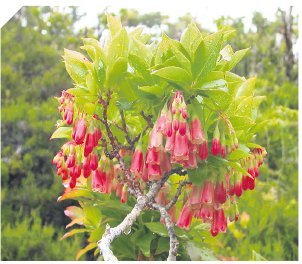
Azorean bilberry (Vaccinium cylindraceum). Photo: Luís Silva-Bioportal Azores.
The Ocean Geographic Society calls the Azores the ‘forgotten Galápagos of the Atlantic Ocean’, describing them as ‘just as remote and biologically rich’. The presence of a great variety of underwater mountains and trenches creates deep upwellings and productive waters around the Azores, attracting a diverse and extensive range of marine animals. No fewer than 28 different species of cetacean swim in the waters of the Azorean archipelago: 21 species of toothed whale and 7 species of baleen whale, roughly a third of all cetacean species worldwide. This places the Azores at the top of the rankings for whale watching (see photo). It would therefore be most surprising if the Oosterschelde were to pass through the area without encountering any cetaceans. Baleen whales in particular – such as blue whales (Balaenoptera musculus) and humpback whales (Megaptera novaeangliae) – make a substantial stopover here during their northward migration, drawn by the plankton bloom that occurs in spring. Sperm whales (Physeter macrocephalus) and Risso’s dolphins (Grampus griseus) are even present year-round. There is also much to discover on the islands themselves and on a smaller scale: in dry moss on Faial and Pico, at least nine species of tardigrade have been found, including two species – Echiniscus azoricus and Bryodelphax atlantis (Zootaxa, 2008) – that have never been recorded anywhere else.
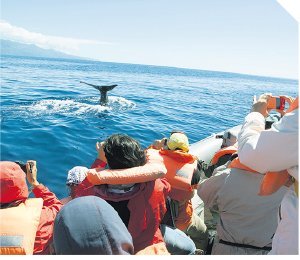
Whale watching off Faial, Azores. Photo: Luca Nebuloni.
1836
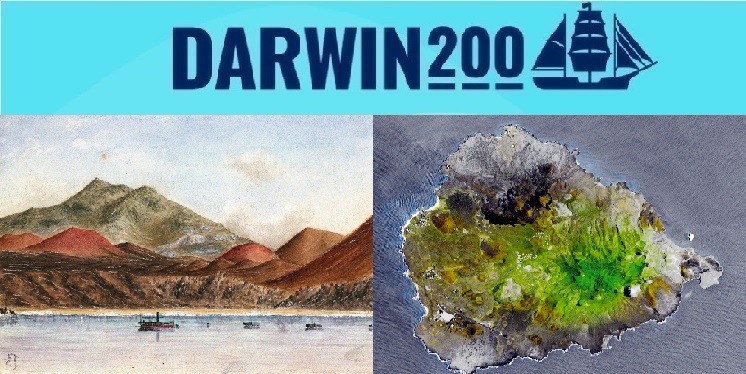
‘Where on earth shall we find a spot where, even after the most careful examination, no signs are to be seen of that endless cycle of change to which this earth has been, is, and will be subjected?’ These words, written by Charles Darwin after his visit to Ascension, read almost like a prophecy about climate change. Ascension is a highly isolated volcanic island, roughly the size of Terschelling, composed almost entirely of basalt and forming a protrusion of the Mid-Atlantic Ridge. After five days at sea, HMS Beagle spent four days at Ascension. At the time, the island was home to 260 people: Royal Navy staff, their families, and a number of formerly enslaved individuals. The naval base had been established in 1815 in case the French took it upon themselves to help Napoleon escape once more – this time from St Helena. On the bare, treeless volcanic island, Darwin studied lava bombs that he believed had been shot into the air in a molten state. He suspected that the climate had been different in the past. The British soldiers stationed there demonstrated, at any rate, that it was possible to grow vegetables successfully on the cooler summit – already known, somewhat ironically, as Green Hill or Mountain (see historical print).
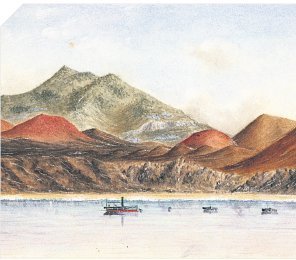
Undated print of Green Mountain on Ascension. Image: C.T., Royal Museums Greenwich.
Ascension takes its name from the Portuguese admiral Alphonse d’Albuquerque, who visited the island on Ascension Day (Asençâo) in 1503. It is also the site where an audacious plan was carried out, conceived by the botanist Joseph Hooker and supported by his friend Charles Darwin. Hooker visited Ascension in 1843 and devised a scheme to literally green the island by planting trees. These would retain rainwater and improve the soil. In 1847 he persuaded the Royal Navy to ship trees and shrubs from Kew Gardens – where his father was director – to Ascension. From 1850 onwards, a variety of trees and shrubs arrived year after year from botanical gardens in Argentina, Europe, and South Africa. By 1880, an abundance of exotic Norfolk Island pines (Araucaria heterophylla), eucalyptus, bamboo, and banana trees were growing on Green Mountain, the island’s highest point, which is some 7 degrees cooler than the coast. A tropical cloud forest has since formed there and is gradually expanding. This ‘alien’ greening is visible even from space (photo), and even in the relatively dry valley the highly invasive mesquite (Prosopis juliflora) is now spreading.
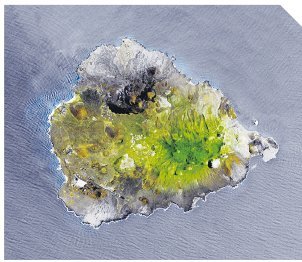
Greening of Green Mountain on Ascension, imaged using Advanced Spaceborne Thermal Emission and Reflection Radiometry (ASTER). Image: Jesse Allen, NASA Earth Observatory.
From 2023 to 2025, the Dutch sailing vessel Oosterschelde is sailing the Darwin200 Global Voyage in 32 legs, taking stock of the state of nature and the environment worldwide – nearly two centuries after Darwin’s own voyage around the world.
1836
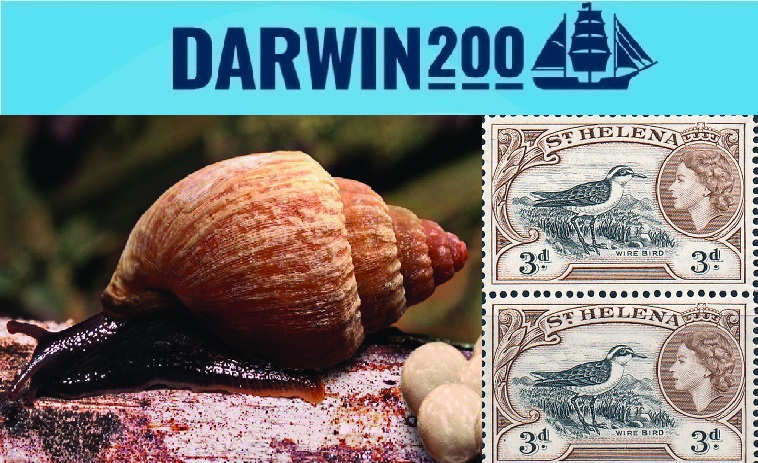
Dhe sailing route to Saint Helena passes through a subtropical high-pressure zone with little to no wind. The Beagle takes nearly three weeks to reach this British resupply station on 8 July 1836. Darwin describes the volcanic island as looking like a ‘castle in the ocean’ and says it reminds him of Wales. He spends five days on Saint Helena and fills an entire notebook, mostly with observations on geology. Darwin also notes that only 52 of the 746 plant species are native. ‘Many imported species must have displaced some of the native ones, and only on the highest and steepest ridges does the native flora still predominate.’ He also observes that goats and pigs are causing widespread damage to the vegetation, and that the ‘great change in vegetation has caused eight species of land snail to become extinct, and probably a multitude of insects’ (the Natural History Museum London produced a reconstruction of the subfossil land snail Chilonopsis nonpareil: see photo). Darwin stays at St Matthew’s vicarage, a stone’s throw from the grave of Emperor Napoleon, who had died in exile there just 15 years earlier. Darwin’s assistant Syms Covington made a sketch of the grave.
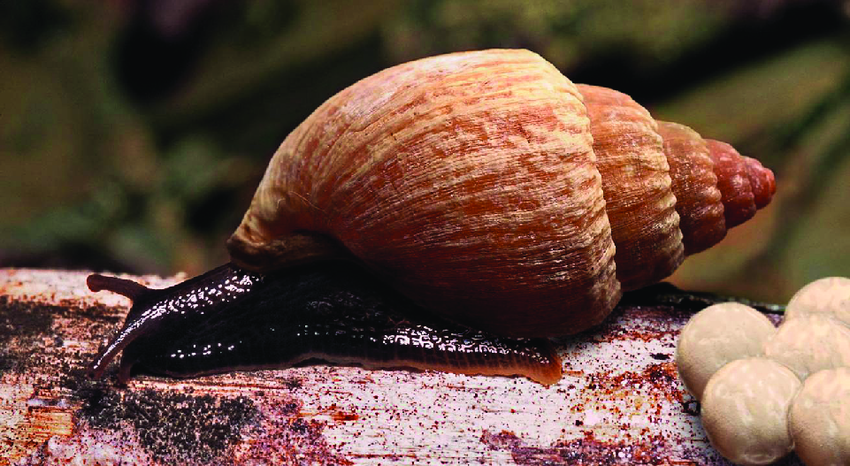
Reconstruction of the land snail Chilonopsis nonpareil. Photo: Harold Taylor, Natural History Museum London.
Saint Helena is smaller than an airport – with a very short runway – but remains a little-visited island. It is mountainous, with rocky coastlines, sandy beaches, clear blue water, and colourful coral reefs, yet has no tourist industry to speak of. Thanks to nearly 14 million years of isolation, Saint Helena is home to around five hundred endemic terrestrial species – more than any other British Overseas Territory. The best known is the Saint Helena plover (Anarhynchus sanctaehelenae), which is also known as the wirebird on account of its extremely slender legs, and has travelled the world on postage stamps many times over (see photo). Deforestation has already driven a number of native flora and fauna to extinction, including the enormous Saint Helena giant earwig (Labidura herculeana, in 1967) and the Saint Helena olive (Nesiota elliptica, in 1994). Since 2000, however, reforestation efforts have been under way through the Millennium Forest project, and several new spider species have recently been discovered, including the mole spider Molearachne sanctaehelenae, the only wolf spider that constructs ‘molehills’ (Arachnology, 2023). Saint Helena is also home to the oldest known living land animal: Jonathan, a Seychelles giant tortoise (Aldabrachelys gigantea) introduced in 1882 and now approximately 192 years old. Jonathan lives as an immigrant on the governor’s estate and was assigned a birthday in 2022: 4 December.

Postage stamps from 1953 featuring the wirebird, or Saint Helena plover (Anarhynchus sanctaehelenae).
From 2023 to 2025, the Dutch sailing vessel the Oosterschelde is sailing the Darwin200 Global Voyage in 32 legs, to take stock of the state of nature and the environment worldwide, nearly two centuries after Darwin’s voyage around the world.
1836
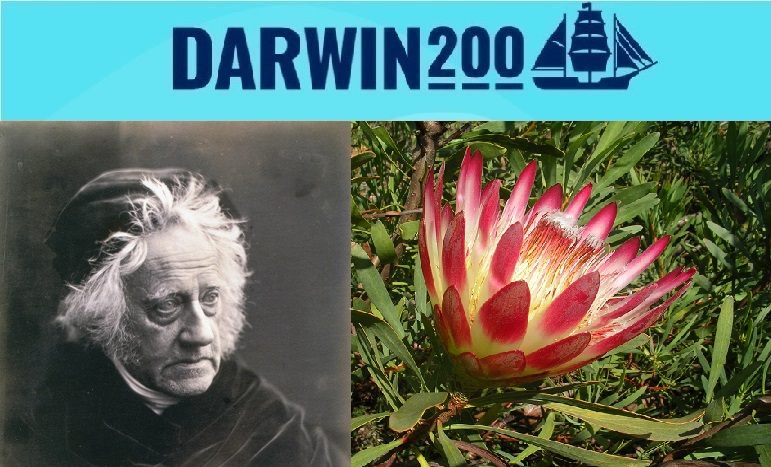
The Beagle lands at Simon’s Town between the Cape of Good Hope and Cape Town on 31 May 1836. The crew have by then completed an exhausting three-week sea voyage across the Indian Ocean from Mauritius. Although Darwin spends eighteen days around Cape Town, visits Table Mountain and the Fynbos, and spends four days on horseback with a Khoi guide travelling through Paarl, Franschhoek and Houwhoek, he collects relatively little. Probably because he knew that the southern Cape had already been thoroughly explored by naturalists. He is most impressed by the Sea Point Contact locality (Lyell Collection, 2023), where granite and slate schist occur together, which poses ‘great difficulties’ for ‘ordinary theory’ but which he believes points to ‘metamorphosis in action’. He himself sees little large wildlife and is surprised by the stories of great herds of elephants, rhinoceroses, giraffes, wildebeest and antelopes in an area that strikes him as ‘sterile’. His most important encounter is with the British astronomer Sir John Herschel, with whom he apparently discusses the origin of species over dinner, whereupon Herschel advises him above all to seek out ‘true causes’ (Julia Margaret Cameron would produce iconic photographic portraits of both men decades later: Herschel (1867, see photo) and Darwin (1881)).
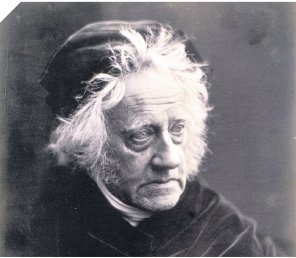
Portrait of Sir John Herschel. Photo: Julia Margaret Cameron (1867).
Hot on the heels of crossing the Pacific Ocean, the Oosterschelde also makes the crossing of the Atlantic to Cape Town. Along the way, two islands are visited that the Beagle never called at: South Georgia and Tristan da Cunha. The first is a true natural paradise, with millions of seabirds, penguins, and large numbers of seals, whales and elephant seals. The volcanic island of Tristan da Cunha is known among biologists above all for the once common but now extinct Tristan moorhen, which according to Dutch genetic research was a subspecies of the – still surviving – Gough moorhen (Gallinula nesiotis, PLOS ONE, 2008). Near Cape Town, three weeks are available for visits to natural sites. For botanists, the Cape is best known as the smallest floral kingdom: the Cape Flora of the Fynbos. Around 10 per cent of all known plant species occur here, including the Protea or sugarbush (king protea, photo). In terms of biodiversity, the Fynbos is far richer than the Kruger National Park, which lies at least a day’s drive away. Attentive botanists have noted, incidentally, that Darwin, in a chalk drawing made when he was 6 years old (with his sister Catharine), is already holding a Fynbos plant: a cultivated Cape cowslip, also known as Cape cowslip (Lachenalia aloides).
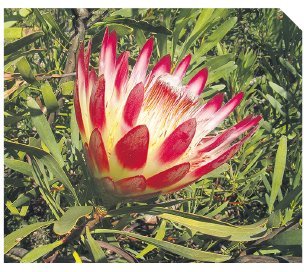
The king protea, giant protea or honeypot (Protea cynaroides) is the national flower of South Africa. Photo: Thijs nl

From 2023 to 2025, the Dutch sailing vessel the Oosterschelde is sailing the Darwin200 Global Voyage in 32 legs, to take stock of the state of nature and the environment worldwide, nearly two centuries after Darwin’s own voyage.
1834
To reach Darwin’s second visit to the Falkland Islands, we must go back two years in time. The Beagle visited this remote island group in the South Atlantic in March 1833 and 1834 (see legs 8–9, Bionieuws 15 December 2023). On both occasions the ship put in at Port Louis, not far from present-day Stanley on East Falkland. The Devonian fossils of brachiopods that Darwin found here gave rise to a century of wrangling among geologists over continental drift (see illustration, Lyell Collection, 2023). 1833 was also a turbulent time: the British had just claimed both islands as an overseas territory by having a local shopkeeper hoist the Union Flag. There were only 25 inhabitants, but the islands received frequent visits from rough-and-ready whalers, sealers and penguin hunters. During the second visit there was murder, theft and plunder, and the Beagle even served briefly as a house of detention. Darwin described the islands as a ‘theatre of iniquity’, an ‘elastic peat bog’ and a ‘very important halting place in the most stormy sea in the world’. He wrote to his sisters that he was surrounded by ‘a great many animals, all of which have to be embalmed and numbered’.
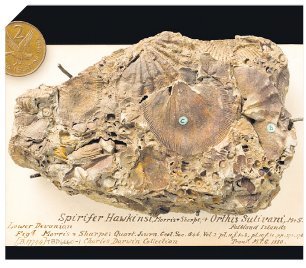
A Devonian fossil found by Darwin, bearing specimens of the brachiopods Australospirifer hawkinsii (label b) and Schellwienella sulivani (label c). Source: Lyell Collection, 2023 / Natural History Museum, London.
2025
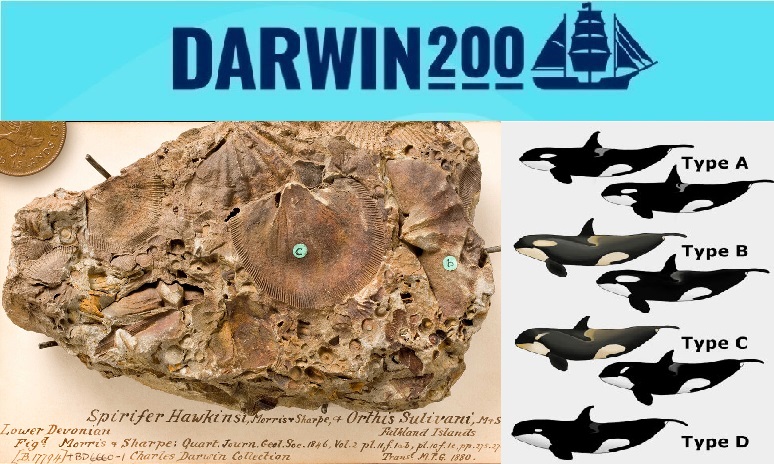
This leg of the Oosterschelde to the Falkland Islands sold out very quickly. ‘Rounding “The Cape of Storms” is for a sailor what reaching the summit of Mount Everest is for a mountaineer’, the Oosterschelde website states. ‘The southern oceans are under the influence of the westerly drift. Water and waves are driven up by this wind. Because there is no land anywhere to slow these waves down, they can grow into enormous mountains of water.’ The winds between 40 and 50 degrees south latitude are therefore nicknamed the Roaring Forties, and this intensifies near Cape Horn, lying somewhat further south still, into the Furious Fifties. The Oosterschelde now – in the summer season – has the wind firmly at her back and hopes to encounter ‘whales, dolphins, penguins and many albatrosses’. With a little luck, perhaps also the extremely rare subantarctic type D killer whale (Orcinus orca type D, see illustration). Some polar researchers suspect this to be a distinct species that hunts in groups for Patagonian toothfish (Dissostichus eleginoides) (Polar Biology, 2010), with smaller teeth, a small white eye patch, a rounded head, and a narrower and shorter dorsal fin than other killer whales.
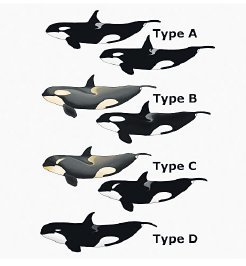
Different killer whale types (Orcinus orca). Source: Albino.orca / Wikipedia

From 2023 to 2025, the Dutch sailing vessel Oosterschelde is sailing the Darwin200 Global Voyage in 32 legs, taking stock of the state of nature and the environment worldwide – nearly two centuries after Darwin’s own voyage around the world.
1836
De Beagle called at New Zealand only once: just before Christmas, on the North Island (see Leg 23: Bionieuws 15). Charles Darwin never visited the South Island, which means he certainly missed the largest iconic kiwi species: the great spotted kiwi or roroa (Apteryx maxima, illustration). He could, however, have collected a little spotted kiwi (Apteryx owenii), for he must have heard the nocturnal calls of this kiwi species during his visit to the Bay of Islands in the north. A missed opportunity, since flightless birds on islands became the subject of fierce debate among naturalists after his return to England. The influential British anatomist Richard Owen postulated ‘that there is no greater anomaly in nature than a bird that cannot fly’. In 1839, on the basis of a single bone sent to him, he concluded that the extinct giant moa must have been a ratite, even larger than the ostrich, and coined the genus Dinornis (‘terrible bird’) for it. Some contemporaries viewed the vestigial wing structures of kiwis and other ratites as failed steps on the path towards flight, but Darwin held firmly – and correctly – to the opposite view: they are rudimentary structures pointing to disuse and the loss of the ability to fly.
 The great spotted kiwi or roroa (Apteryx maxima). Lithograph:
Rattus exulans) around AD 1250–1300 almost certainly contributed to the extinction of the moas – which grew up to 3.5 metres tall – and of the enormous Haast’s eagle (Hieraaetus moorei), which preyed on moas. A number of smaller bird species also became extinct, particularly after European ships began bringing brown rats, cats, stoats, weasels and ferrets ashore from the late 18th century onwards. Millions of years of evolution in the absence of land mammals had turned many New Zealand birds into ground-nesting and ground-dwelling species, making them especially vulnerable to predation. One well-documented extinction is that of the flightless Lyall’s wren (Traversia lyalli, photo) on the tiny Stephens Island between the two main islands. This was probably the last place where the bird had managed to survive, but lighthouse keeper and amateur ornithologist David Lyall documented the extinction of this wren in 1894 through catches made by his domestic cat, Tibbles, within the space of a year – a record for the speed of an extinction.
A mounted specimen of Lyall’s wren (Traversia lyalli). Photo: Te Papa Tongarewa – Online Bird Collection.
From 2023 to 2025, the Dutch sailing vessel the Oosterschelde is sailing the Darwin200 Global Voyage in 32 legs, to take stock of the state of nature and the environment worldwide – nearly two centuries after Darwin’s own voyage around the world.
1836
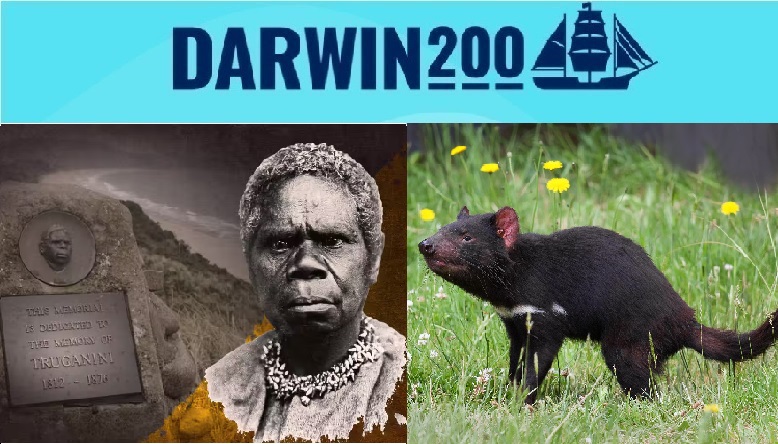
Darwin’s Beagle spent ten days in Tasmania (then known as Van Diemen’s Land) in February 1836. Darwin celebrated his 27th birthday there, visited the port city of Hobart, climbed Mount Wellington, and was struck by the enormous tree ferns on the island. At the time, around 36,000 colonists lived there. ‘All the aborigines have been removed to an island in Bass’s Strait, so that Van Diemen’s Land enjoys the great advantage of being free from a native population. This step appears to have been inevitable, as the only means of stopping the robberies, burnings, and murders committed by the blacks’, Darwin observed – though he did add that this was the consequence of ‘the misconduct of some of our countrymen.’ Of the approximately 5,000 original Palawa Aboriginal people in Tasmania, barely 100 remained alive thirty years after colonisation, largely because the colonists had shot their principal food source: kangaroos. The surviving and rebellious Palawa were deported to Flinders Island in 1835, and of these only 47 returned to Tasmania in 1847. Truganini, the last full-blooded Palawa, who died in 1876, now has a nature reserve near Hobart named after her (illustration).
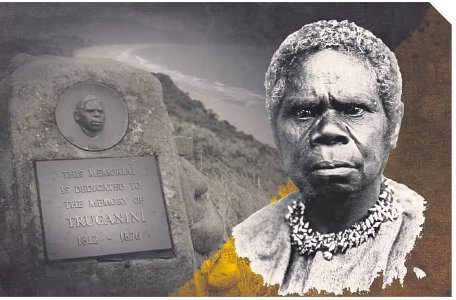
A commemorative plaque at the nature reserve near Hobart named after Truganini (c.1812–1876), the last full-blooded Palawa. Image: Special Broadcasting Service, Australia.
Having reached its turning point in Sydney, the Oosterschelde is now truly on its way home. The sail along the coast of New South Wales is manageable, but the exposed crossing of Bass Strait to Tasmania can be challenging. The island’s capital, Hobart, in the south-east, is now known as a welcoming city with a colonial heritage, traditional pubs, and excellent vineyards. Nature lovers may be more drawn to the Lutruwita forests, home to mountain ash (Eucalyptus regnans) reaching up to 100 metres in height – the tallest flowering trees in the world. These forests are also home to the island’s most famous marsupial: the Tasmanian devil (Sarcophilus harrisii, photo), the largest carnivorous marsupial that has not yet gone extinct. The population on the Australian mainland died out some 3,000 years ago, possibly due to the spread of feral dingoes (Canis lupus dingo). In Tasmania too, the population has been declining sharply since the 1990s, primarily due to a contagious form of cancer. One can only hope the devil does not go the way of the thylacine (Thylacinus cynocephalus): the last individual died in 1936 at Hobart Zoo, and all that remains are deeply distressing film footage.
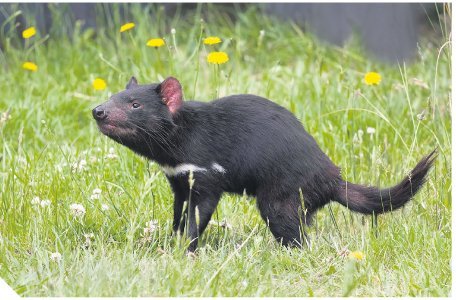
A Tasmanian devil (Sarcophilus harrisii). Photo: JJ Harrison
From 2023 to 2025, the Dutch sailing vessel Oosterschelde is sailing the Darwin200 Global Voyage in 32 legs, to take stock of the state of nature and the environment worldwide, nearly two centuries after Darwin’s own voyage around the world.
1836
Darwin’s Beagle left New Zealand on 30 December, and the crew saw in the New Year on the Tasman Sea. On 12 January 1836, the sailing ship passed the lighthouse at Port Jackson, the harbour of Sydney, which at the time had 23,000 inhabitants. The arrival was earlier than expected, meaning there was no post from home. ‘I have a great desire to sit down and have a good cry’, Darwin wrote to his sister Susan. His first visit to Sydney nonetheless filled him with pride. ‘A glorious testimony to the power of the British nation. (..) My first feeling was to congratulate myself that I was born an Englishman.’ Darwin undertook an expedition to the Blue Mountains, bought two boomerangs like a modern tourist, and spotted several platypuses (Ornithorhynchus anatinus) in a small lake, which ‘dived and played about the surface of the water like so many water-rats’ (illustration). Two months later he would also spend eight ‘dull and uninteresting’ days at King George Sound in the far south-west of Australia, and on departing described the fifth-largest country in the world as ‘a rising child and Australia will be a great nation and a great city’.
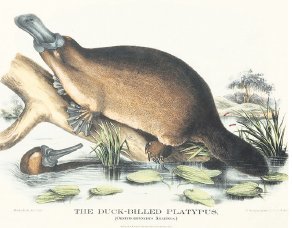
Lithograph of a platypus (Ornithorhynchus anatinus) by Harriet Scott and Helena Forde (c. 1871).
2024
‘The Tasman Sea, between New Zealand and Australia, is no easy sailing ground’, warns the website of the sailing vessel Oosterschelde. ‘We will regularly have to reef or change course or alter our sail plan. We take turns at the helm and keep our eyes open for migrating whales and all the species of seabird we might encounter here.’ The sailing ship is now welcomed into the harbour of Sydney by the iconic Opera House, which inspired Danish architect Jørn Utzon through the image of sails. The Oosterschelde moors in the heart of this world city, home to well over five million people, and will spend twelve days there. The region around Sydney, like other Australian coastal areas, has been increasingly afflicted in recent decades by devastating bushfires, and has an online warning system, MyFireWatch, similar to our Buienradar. Fires also threaten the unique ‘dinosaur trees’ of Wollemi National Park, where only 89 wild specimens now remain of the Wollemi pine Wollemia nobilis (photo), a ‘living fossil’ that has existed for more than 200 million years. Another tourist attraction in this park are the bioluminescent glowworms – larvae of Arachnocampa fungus gnats – found in old railway tunnels.
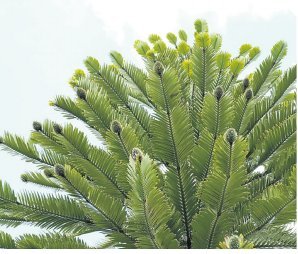
Crown of the ‘living fossil’, the Wollemi pine (Wollemia nobilis). Photo: iNaturalis.
From 2023 to 2025, the Dutch sailing vessel the Oosterschelde is sailing the Darwin200 Global Voyage in 32 legs, to take stock of the state of nature and the environment worldwide, nearly two centuries after Darwin’s voyage around the world.
1835
Around Christmas, HMS Beagle spent nine days visiting the North Island of New Zealand. She moored in the Bay of Islands, and Darwin was in poor spirits, plagued by the seasickness, claustrophobia and homesickness that had tormented him throughout the voyage. He described the English residents – mostly convicts who had fled from Australia – as ‘worthless fellows’ and ‘addicted to drunkenness and every kind of vice’. He also called the indigenous Māori ‘filthy and disgusting’, and was in fact only positive about their traditional greeting ceremony: the pressing of noses (see lithograph by Antonio Bernati). Partly on foot and partly by boat, and accompanied by a very talkative Māori chief, he and Captain FitzRoy visited the Waimate Mission. This was an oasis of English civilisation, complete with cups of tea and cricket on the lawn. Darwin himself praised the servant girls for their ‘clean, tidy and healthy appearance, like that of dairy maids in England’. On his departure on 30 December, Darwin noted that everyone was glad to be leaving New Zealand. ‘It is not a pleasant place. (…) I look back on only one bright spot, and that is Waimate, with its Christian inhabitants.’
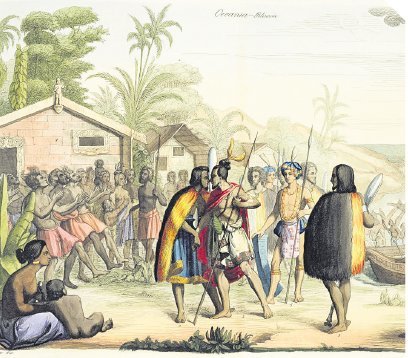
Ceremonial nose-pressing, the greeting ritual of the Māori. Lithograph by Antonio Bernati–Giacomo Casa (1835–87).
The Oosterschelde visits New Zealand twice. At the end of September the destination is subtropical Whangarei on the North Island, and shortly after Christmas the sailing vessel visits Christchurch on the wilder and more rugged South Island. The more densely populated North Island is best known for its beautiful beaches, geothermal activity and Māori culture. It has abundant wildlife, including in the national parks of Egmont, Te Urewera, Whanganui and Tongariro (see photo), the oldest park still containing ancient forest with native conifers, tree ferns and kāmahi trees (Weinmannia racemosa). In that area, heather (Calluna vulgaris), introduced in 1912 with the aim of hunting red grouse, is now a persistent invasive species causing concern among ecologists. Another environmental problem in New Zealand will sound familiar: too much nitrogen as a result of intensive dairy farming. Dairy is the country’s most important export product. Dairy farmers in New Zealand are therefore now permitted to apply no more than 190 kilograms of nitrogen per hectare in artificial fertiliser. This has already led to significant farmers’ protests, and this summer the centre-right government scrapped the previously proposed burp tax, aimed at reducing methane emissions from livestock (BBC, 11 June).
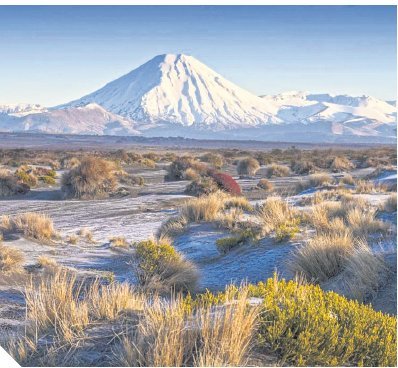
Mount Tongariro, a steep stratovolcano on the North Island. Photo: Department of Conservation, New Zealand.
From 2023 to 2025, the Dutch sailing vessel Oosterschelde is sailing the Darwin200 Global Voyage in 32 legs, taking stock of the state of nature and the environment worldwide – nearly two centuries after Darwin’s own voyage around the world.
1835
Neither Tonga nor Fiji lay on the route taken by HMS Beagle across the Pacific in 1835. It therefore remains a matter of speculation what a hypothetical visit to the Fijian islands, surrounded by coral reefs and atolls, would have meant for Darwin’s theory of coral island formation. That theory, published in 1842, was long highly controversial and amounts, in brief, to the idea that atolls form through the upward growth of coral as the seabed gradually subsides (see illustration). In his autobiography, Darwin claims that the theory arose purely from his deductive mind: ‘The whole theory was thought out on the west coast of South America before I had seen a true coral reef. I had therefore only to verify and extend my views by a careful examination of living reefs.’ The Fijian islands seem ideal for such a test, but the reality check actually took place only when the Beagle called at the atoll islands of Cocos and Keeling in the Indian Ocean in April 1836 – islands that the Oosterschelde is not visiting, precisely because the sailing vessel heads eastward towards the Atlantic Ocean after Australia ‘for logistical reasons’, and therefore does not circumnavigate the globe entirely.
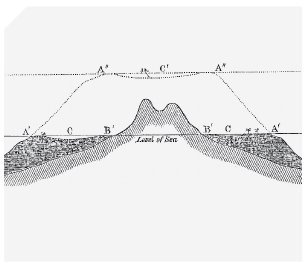
Atoll formation at the Cocos (Keeling) coral islands. Source: The Structure and Distribution of Coral Reefs, Charles Darwin, 1842.
With more than three hundred volcanic islands, relatively recently formed and lying in isolation in the middle of the South Pacific on the boundary between Polynesia and Melanesia, Fiji is home to remarkable endemic species, including its own iguanas, parrots, and fruit doves. It is as much a laboratory for evolutionary radiation as Hawaii and the Galápagos, with spectacular examples found in freshwater snails (family Tateidae), sweat bees (family Halictidae), and trap-jaw ants (genus Strumigenys) – which admittedly capture the imagination somewhat less readily than honeycreepers, giant tortoises, Darwin’s finches, or giant daisies. Of the twenty endemic species of trap-jaw ant in the Fijian archipelago, for example, fourteen have been confirmed with certainty to derive from a single colonisation event (Evolution, 2020). To analyse the ecological specialisation of the ants as thoroughly as possible, Japanese evolutionary biologists from the Okinawa Institute of Science and Technology left nothing to chance. The DNA of the ant species was sequenced, and both genotype and phenotype were mapped as comprehensively as possible using X-ray microtomography and 3D morphometrics (see photo: a 3D model of Strumigenys nidifex). Through precise measurements of bodies, eyes, and above all the characteristic jaws, it was established that trap-jaw ants in highland areas are larger and possess shorter jaws, enabling them to capture larger prey.
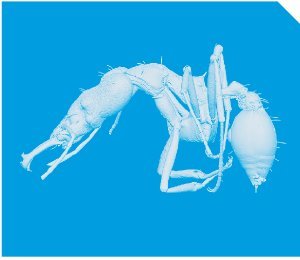
3D model of the trap-jaw ant Strumigenys nidifex. Source: SketchFab / Okinawa Institute of Science and Technology.
From 2023 to 2025, the Dutch sailing vessel the Oosterschelde is sailing the Darwin200 Global Voyage in 32 legs to assess the state of nature and the environment worldwide, nearly two centuries after Darwin’s own voyage.
1835
On its way from Tahiti to New Zealand, HMS Beagle passed the Tonga Islands at a distance of a few hundred kilometres in early December 1835. The sight of a few white terns on 11 December did not necessarily mean land was near, Captain Robert FitzRoy noted in his diary. ‘Birds with short wings, such as cormorants or gannets, rarely venture a hundred miles from land’, he wrote. But outside the breeding season, ‘determined seabirds, such as albatrosses and the entire petrel family’, offered no indication whatsoever of land nearby, according to FitzRoy. The Kingdom of Tonga was not founded until 1875 by King Tupou I, who united the island groups of Vava’u, Ha’apai, and Tongatapu. The inhabitants of Tongatapu had already been converted to Christianity from 1826 onwards by missionaries of the London Methodist Society, a legacy still recalled by a church built in 1835 near Peka. For geologists, an equally striking ‘monument’ is Tsunami Rock – consisting of seven coral boulders, the largest measuring some 30 by 10 metres (see photo) – which were most likely hurled onto the coast as a result of a seaquake following the collapse of a submarine volcano (Frontiers in Earth Science, 2021).
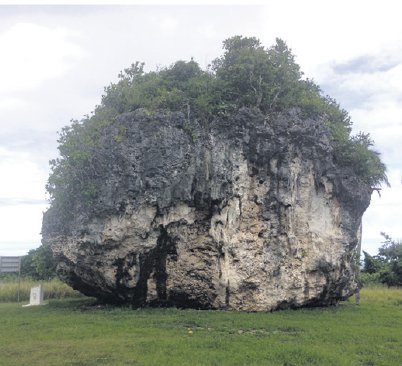
Tsunami Rock on Tongatapu. Source: Tauʻolunga, Wikipedia.
2024
This summer, the Kingdom of Tonga unfortunately left the Olympic Games without a medal, yet it remains the smallest independent country ever to have won a medal at the Summer Games: a silver medal by super-heavyweight boxer Paea Wolfgramm in 1996. Pule’anga Fakatu’i ‘o Tonga, as the kingdom is formally known in Tongan, comprises 177 small islands, 36 of which are permanently inhabited by around one hundred thousand subjects. Dutch explorers Willem Schouten and Jacob Le Maire were the first Westerners to visit Tonga in 1616, and Abel Tasman named the main island Tongatapu Amsterdam in 1643. There he traded white cotton, an old sail, nails, two mirrors, and some beads for water, dozens of pigs, seventy chickens, coconuts, and bananas. Agricultural production – of yams, pumpkins, vanilla, watermelons, and legumes in particular – remains a cornerstone of Tonga’s economy. The flora shows many similarities with the nearby Samoan and Fijian islands, and in terms of wildlife the Kingdom is best known for the endemic, yellow-plumaged Tongan whistler (Pachycephala jacquinoti, photo) and the fruit-eating Tongan flying fox (Pteropus tonganus).
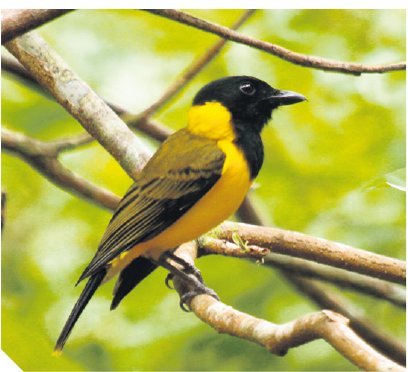
The Tongan whistler (Pachycephala jacquinoti). Photo: iNaturalist.
From 2023 to 2025, the Dutch sailing vessel the Oosterschelde is sailing the Darwin200 Global Voyage in 32 legs to assess the state of nature and the environment worldwide, nearly two centuries after Darwin’s own voyage.
1835
Westward bound for Tahiti, the Beagle crosses the international date line, and as a result 16 November 1835 is missing from the logbook. Darwin is full of admiration for the Tahitian men, whom he considers tall, broad-shouldered and athletically built, though he is less taken with the women. ‘An unflattering fashion is (…) the circular cutting or rather shaving of the hair on the top of the head’, Darwin writes. ‘But it is the fashion, and that is a sufficient answer at Tahiti as well as at Paris.’ He also makes a three-day excursion into the interior and is struck by the large quantities of vegetables and fruit the Tahitians eat: ‘I never saw any people who appeared to live so entirely on vegetables.’ Before their departure, Captain FitzRoy still has a minor dispute to settle with Queen Pōmare IV (pictured): an outstanding bill of 3,000 dollars for the plundering of a British merchant vessel. The queen promises to pay this in kind: in 36 tonnes of pearl oyster shells. As a farewell, she is received on board HMS Beagle on 22 November for a dinner. According to Darwin, she has a gloomy air and ‘only one royal attribute: a perfect immovability of expression under all circumstances’.
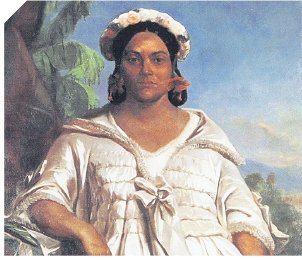
Detail from the portrait of Queen Pōmare IV of Tahiti by Charles Giraud (1851). Source: Musée de Tahiti et des Îles, Wikipedia.

2024
Perhaps because the summer holidays are approaching, the Oosterschelde is calling not only at the popular Tahiti but also at a string of tropical Polynesian islands that HMS Beagle sailed past, such as Bora Bora and the Cook Islands. Leg 19 promises a visit to ‘picturesque beaches’, ‘beautiful anchorages’ and ‘famous waterfalls’, and even ends where it begins: in Papeete on Tahiti. The leg to the Cook Islands will likely face strong trade winds, promising high seas and a fast, rolling crossing. The final destination, Rarotonga, is the largest and most densely populated island of the fifteen Cook Islands, an independent state in free association with New Zealand. The volcanic island consists predominantly of basalt, and at its centre lies a mountain range whose highest peak, Te Manga, reaches 652 metres. On the mountain slopes, rainforest still grows in relative undisturbed conditions, home to the endemic mato willow Homalium acuminatum and the strikingly red-flowered composite Fitchia spesiosa (photo, left) and the myrtle representative Metrosideros collina (photo, right). The Polynesian coral islands are of course best known as paradises of blue seas, brilliant white beaches, swaying palm trees and glorious sunshine, but they are increasingly grappling with the consequences of sea-level rise, overfishing, ocean acidification, waste dumping and coral bleaching.
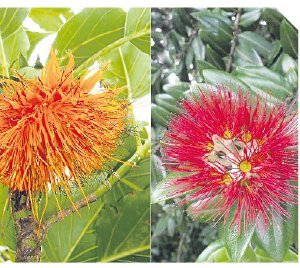
The red-flowered composite Fitchia spesiosa (left) and myrtle representative Metrosideros collina (right). Photos: Peter de Lange, Encyclopedia of Life.
From 2023 to 2025, the Dutch sailing vessel Oosterschelde is sailing the Darwin200 Global Voyage in 32 legs, to take stock of the state of nature and the environment worldwide – nearly two centuries after Darwin’s own voyage around the world.
1835
Darwin set foot on neither Pitcairn nor Mangareva. HMS Beagle left the Galápagos Archipelago on 20 October 1835 from Isla Pinta, the island where the famous giant tortoise Lonesome George was later born. This last representative of the tortoise species Chelonoidis abingdonii died on 24 June 2012 at the age of 102, displaced to the Charles Darwin Research Station on Santa Cruz. The Galápagos–Tahiti leg, at 5,700 kilometres, was the longest ocean crossing the Beagle made, and took nearly a month. A considerable distance to the north-west of Pitcairn and Mangareva, the ship passed the many ring-shaped lagoon islands of the Tuamotu Archipelago (see photo). The archipelago’s nickname – the Dangerous or Low Archipelago – is well earned: the area is riddled with shallow reefs around atolls so low-lying that they are not always spotted by sailors. ‘These low islands bear no proportion to the vast ocean out of which they rise’, Darwin writes. ‘It is wonderful that such a force as the waves of that great sea, which so improperly is called the Pacific, has not long ago overwhelmed them.’
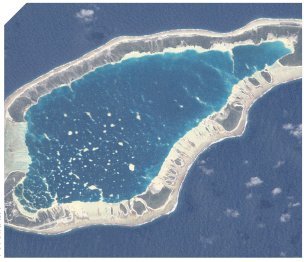
Lagoon island in the Tuamotu Archipelago. Photo: NASA, Wikipedia.
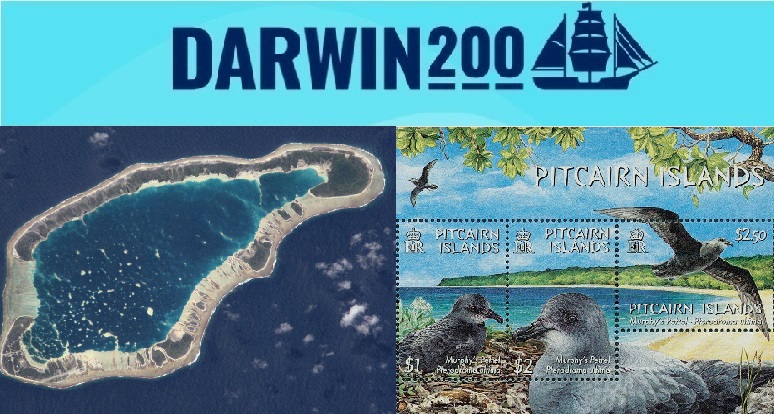
The tiny Pitcairn Island – even smaller than Rottumerplaat – owes its fame to another British vessel: HMAV Bounty. Nine mutineers fled to this island after their mutiny in 1790, accompanied by nineteen Tahitian companions. The approximately fifty current inhabitants are descended from them, and the ship’s bell of the Bounty hangs in the village square of Adamstown. The island has no airport or harbour and is widely regarded as the most remote inhabited place on Earth. An important source of income is the sale of postage stamps to collectors, such as those depicting Murphy’s petrel (Pterodroma ultima, illustration), a common breeding bird on islands in the eastern Pacific and named after an American seabird expert. The Oosterschelde also calls at Mangareva, three times the size of Pitcairn and the main island of the Gambier Islands. Originally a densely forested island, it underwent deforestation comparable to that of Easter Island. Here too, a large proportion of the local population perished following the introduction of infectious diseases by missionaries and colonisers. The island and surrounding atolls are home to 45 bird species, including the endemic Tuamotu sandpiper (Prosobonia parvirostris), Mangareva kingfisher (Todiramphus gambieri), blue lorikeet (Vini peruviana), Mangareva reed warbler (Acrocephalus astrolabii) and Polynesian ground dove (Pampusana erythroptera).
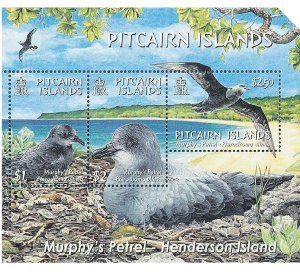
Series of Pitcairn postage stamps from 2004 featuring Murphy’s petrels (Pterodroma ultima). Source: The Joy of Stamps
From 2023 to 2025, the Dutch sailing vessel Oosterschelde is sailing the Darwin200 Global Voyage in 32 legs to take stock of the state of nature and the environment worldwide, nearly two centuries after Darwin’s own voyage.
1835
HMS Beagle set course directly for Tahiti on 20 October 1835: Darwin therefore never visited Easter Island (Rapa Nui). This most remote inhabited island in the Pacific Ocean was ‘discovered’ more than a century earlier, on Easter Sunday, 5 April 1722, by the Middelburg-born Jacob Roggeveen, who promptly named it Paasch Eyland. Roggeveen was sailing for the Dutch West India Company with three ships and 224 men in search of the mythical southern continent (Terra Australis). On this rocky island he encountered some two to three thousand Polynesian inhabitants, ten of whom were shot dead in a panic caused by a misunderstanding. Even so, after this one-day visit, Roggeveen received around sixty chickens and thirty bunches of bananas from the hospitable population – the makers of the colossal Moai statues. Easter Island subsequently received visits from Spaniards (1770), English (1774), French (1786, illustration) and Russians (1802), until in the true year of catastrophe, 1862, Peruvian slave ships appeared on the horizon. They carried off a third of the population for forced labour in mines. Only fifteen returned to Rapa Nui, and at least one of them introduced smallpox to the island. By 1877 just 110 Easter Islanders remained, and in 1880 Chile annexed the island.
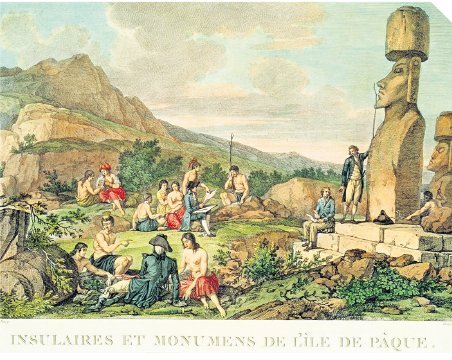
Hand-coloured print of the French visit to Easter Island. Source: Atlas de Voyage de La Pérouse, Gaspard Duché de Vancy, 1797.
Much has been written about the mysterious and colossal Moai statues on Rapa Nui (literally: large rock): some nine hundred were carved, and fifty now stand upright. The island – roughly the size of Texel – was already colonised before 1250, probably by no more than a single boatload of Polynesians. Rapa Nui has been held up by several authors – including the biologist Jared Diamond (Collapse, 2005) – as a cautionary example of resource depletion and ecological collapse. At least seven native bird species – a heron, a rail, a chicken relative, an owl, a storm petrel, and two parrots – have since gone extinct, as has the large native palm tree (Paschalococos disperta). The felling of trunks to transport the 18-tonne statues is said to have led to deforestation, followed by inter-tribal conflict, famine, and even cannibalism. The Leiden environmental biologist Jan Boersema, among others, disputes this narrative of cultural and ecological collapse through overexploitation, and argues instead that it was primarily the introduced – and now locally extinct – Polynesian rat (Rattus exulans, see photo) that sealed the fate of the Easter Island palm (Beelden van Paaseiland, 2020). Since 1995, Rapa Nui has been on Unesco’s World Heritage List, and today the growing numbers of arriving tourists – around 120,000 for a population of 8,000 (in 2018) – represent the major ecological challenge.
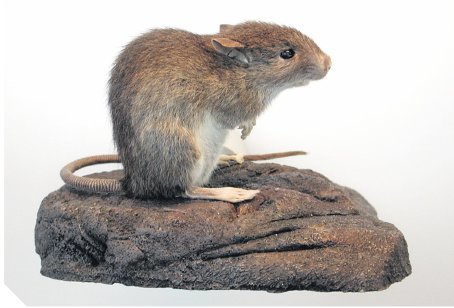
The Polynesian rat (Rattus exulans), now extinct on Rapa Nui. Photo: Cliff (Wikipedia).
From 2023 to 2025, the Dutch sailing vessel the Oosterschelde is completing the Darwin200 Global Voyage in 32 legs, surveying the state of nature and the environment worldwide – nearly two centuries after Darwin’s own voyage around the world.
Here is the iconic stop of the Darwin200 expedition, yet it is a persistent misconception that Charles Darwin experienced his evolutionary eureka moment here in 1835. He set foot on four Galápagos islands – San Cristóbal, Floreana, Isabela and Santiago – and spent most of his time there hunting for volcanoes. Because of the currents, visiting each island took a great deal of time, meaning Darwin spent less than half of the forty days ashore. He was impressed by the marine iguanas (Amblyrhynchus cristatus, ‘disgusting clumsy lizards’; see photo) and by the tameness of the birds: a sizeable Galápagos hawk (Buteo galapagoensis) landed – most unwisely – on the barrel of his rifle. He also noted that the giant tortoises and mockingbirds differed from island to island, observed that the birds were related to those of South America, but unfortunately collected specimens from several islands in a single bag. Darwin dissected a marine iguana and even held a live specimen underwater for an hour to establish that they graze on algae whilst swimming and diving. He took a joyride on a giant tortoise, and on departure the Beagle took no fewer than forty land iguanas and fifty live giant tortoises on board – as provisions (and two small tortoises as pets).
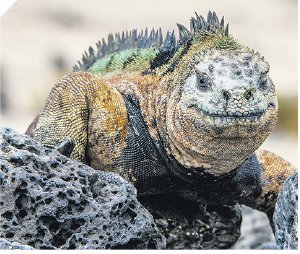
The ‘disgustingly clumsy’ marine iguana (Amblyrhynchus cristatus). Photo: Naturalis.
Galápagos is, after Hawaii, the most studied archipelago for species radiation: with at least fourteen species of Darwin’s finches, fourteen (sub)species of giant tortoises, and fifteen species of tree- and shrub-forming Scalesia composites, all endemic to the Galápagos archipelago. In 1835 the archipelago was still almost uninhabited, but today at least 25,000 people live on the islands of Santa Cruz, Isabela, San Cristóbal and Floreana, and the archipelago receives around 220,000 tourists each year. Around 1965 the first cruises began, which roughly coincides with the establishment of the Estación Científica Charles Darwin research station and the introduction of nature conservation measures. Since 1959, 97.5 per cent of the land area has been a protected nature reserve, and since 1998 some 200,000 square kilometres have been designated as a marine reserve. Eradication programmes have been drawn up for invasive species – rats, cats, pigs, and fire ants – and a captive breeding programme for giant tortoises has saved several (sub)species from extinction. By the end of 2017, more than 7,000 juvenile tortoises had been reintroduced to their islands of origin. A politically charged issue is the regulation of the harvest of edible sea cucumbers, in particular the Asian-prized – but also threatened – pepino del mar (Isostichopus fuscus, photo
).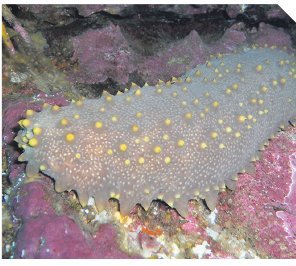
The sea cucumber pepino del mar (Isostichopus fuscus), prized in Asia. Photo: Rein Ketelaar, iNaturalist.
From 2023 to 2025, the Dutch sailing vessel the Oosterschelde is completing the Darwin200 Global Voyage in 32 legs, surveying the state of nature and the environment worldwide – nearly two centuries after Darwin’s own voyage around the world.
1835
Darwin spent around seven weeks in Peru from 19 July 1835. He never set foot on the mainland of Ecuador and therefore never visited Puerto Lucía either. Dropped off at the port city of Callao, Darwin travelled by stagecoach to Lima in the company of his then 19-year-old assistant Syms Covington, a ship’s boy he had taken into his service during the voyage. Eight watercolours by Covington are known from the journey to Lima, and women feature in seven of them (see: three Lima watercolours). Darwin, too, was apparently struck by the ‘Lima Ladies’, dressed in their barely revealing mantles. ‘The ladies, like mermaids, surpassed everything; I could not keep my eyes off them’, Darwin wrote, praising their ‘white silk stockings’ and ‘very beautiful feet’. Meanwhile, Captain FitzRoy evacuated the survivors of the British ship HMS Challenger, which had run aground on the rocks in Chile, and put them on their way home from Concepción. In early September he picked up the by-now restless Darwin and his companions at Callao, and the Beagle then sailed directly to the Galápagos Islands in around ten days.
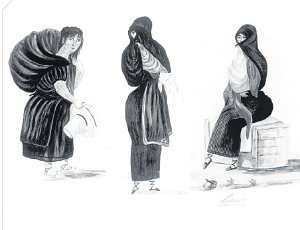
Three drawings of women in Lima, made in 1835 by Darwin’s assistant Syms Covington. Source: The Journal of Syms Covington, ASAP.
2024
The former fishing village of Puerto Lucía now functions primarily as a marina and lies to the west of the port city of Guayaquil, now Ecuador’s largest city. It is situated close to the popular sandy beaches of Chipipe and Salinas. Also nearby is the Museo de Ballenas, a whale museum founded by the Fundación Ecuatoriana para el Estudio de Mamíferos Marinos. The museum houses Ecuador’s largest collection of marine mammal skeletons, representing four species of baleen whale – with a complete skeleton of the humpback whale (Megaptera novaeangliae) as its centrepiece –, ten species of dolphins and toothed whales, and three species of sea lions. April is a little early, but between June and September boat trips can also be booked to observe the sometimes spectacularly breaching humpbacks (photo) off the coast of Machalilla National Park. The humpbacks migrate from Antarctic waters to the warmer waters of the Pacific to breed. Whale-watching can optionally be combined with a visit to Isla de la Plata, the ‘little Galápagos island’, where Galápagos sea lions (Zalophus wollebaeki) and blue-footed boobies (Sula nebouxii) can at least already be seen.
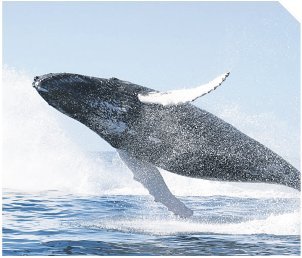
A breaching humpback whale (Megaptera novaeangliae). Source: Wikipedia.
From 2023 to 2025, the Dutch sailing vessel the Oosterschelde is completing the Darwin200 Global Voyage in 32 legs, surveying the state of nature and the environment worldwide – nearly two centuries after Darwin’s own voyage around the world.
1835
‘In a straight line northwards, the distance along the coast is only 420 miles, but owing to my manner of travelling it became a very long journey’, writes Charles Darwin about his overland journey on horseback through northern Chile. Over two months he travels by land from Valparaíso to Copiapó, where he is picked up again by the Beagle. His route takes him through several mining districts where metals are extracted, and past the stepped gravel terraces near Huasco. In Arqueros he relishes a good night’s sleep: ‘from a cause which will not be fully understood in England, namely the absence of fleas!’ In his view, fleas simply cannot survive at altitudes of nine hundred to twelve hundred metres, though he has no satisfactory explanation for this. In Peru he visits the ruins of old Callao, destroyed in 1746 by an earthquake and tidal wave, and those of an ancient indigenous village. ‘When we look at their pottery, woollen garments, elegantly formed objects (…), copper tools, ornaments with precious stones, palaces and hydraulic works, we must feel respect for their considerable advances in the arts of civilisation’, Darwin observes. He even describes their burial mounds, or huacas (see photo: Huaca Pucllana, near Lima, Paulo JC Noguiera), as ‘truly wonderful’.
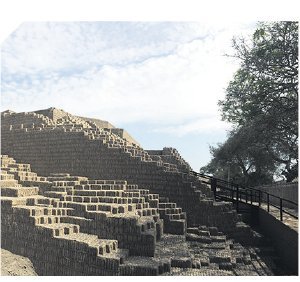
The burial mound Huaca Pucllana near Lima. Photo: Paulo JC Noguiera, Wikipedia.
2024
In Peru, alongside Lima’s Circuito Mágico del Agua, spotting seabirds and whales or swimming with dolphins also feature prominently on tour operators’ programmes. They also warmly recommend a visit to the Ballestas Islands – ‘the Galápagos for the poor’ – where sea lions or eared seals (Otaria flavescens) and seabirds such as Humboldt penguins (Spheniscus humboldti, see photo) and Guanay cormorants (Leucocarbo bougainvillii) live. The islands are composed of limestone and guano, but lie too close to the coast to harbour unique endemic species. A comparable nature excursion is offered by the four Palomino Islands – ‘the little Galápagos of Lima’ – which lie closer to Callao. They are particularly popular for their large sea lion colonies. The smell of bird droppings can be quite overpowering, but swimming with sea lions apparently more than makes up for it. The Ballestas and Palominos are part of the Reserva Nacional Sistema de Islas y Puntas Guaneras (RNSIIPG), which manages 22 islands and island groups with a total area of 140,000 hectares along the Peruvian coast. The organisation protects the species present, promotes scientific research and education, and ensures the sustainable management of guano and stocks of fish and marine invertebrates.
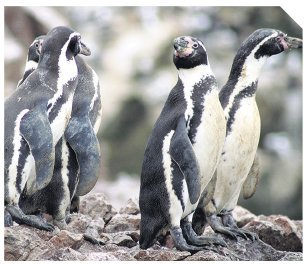
Humboldt penguins (Spheniscus humboldti). Source: Wikipedia.
From 2023 to 2025, the Dutch sailing vessel the Oosterschelde is completing the Darwin200 Global Voyage in 32 legs, surveying the state of nature and the environment worldwide – nearly two centuries after Darwin’s own voyage around the world.
1835
‘Never in the same span of time have I experienced so much enjoyment’, writes Charles Darwin of the four weeks he spends travelling through the Cordillera behind Valparaíso and Santiago de Chile. His companions on his greatest geological excursion through the Andes are a muleteer, ten mules and a madrina. ‘The madrina (or godmother) is a most important personage: she is an old, steady mare, with a bell round her neck; and wherever she goes, the mules follow her as faithfully as good children’, Darwin writes. ‘Of our ten animals, six were for riding and four for carrying baggage.’ He throws himself wholeheartedly into the geology of the region and, near Agua de la Zorra, discovers a petrified forest containing some fifty tree stumps. ‘There was little difficulty in understanding the marvellous story which this scene at once unfolded.’ The heavily plundered site is now known as Darwin Forest, a subtropical forest from the Middle Triassic containing 240-million-year-old conifers, corystosperms (‘seed ferns’) and an understorey of horsetails and ferns (see reconstruction, Revista de la Asosciación Geológica Argentina, 2009).
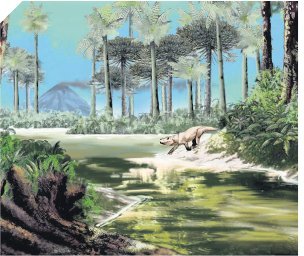
Reconstruction of the fossil forest at Agua de la Zorra. Source: Revista de la Asosciación Geológica Argentina, 2009.
2024
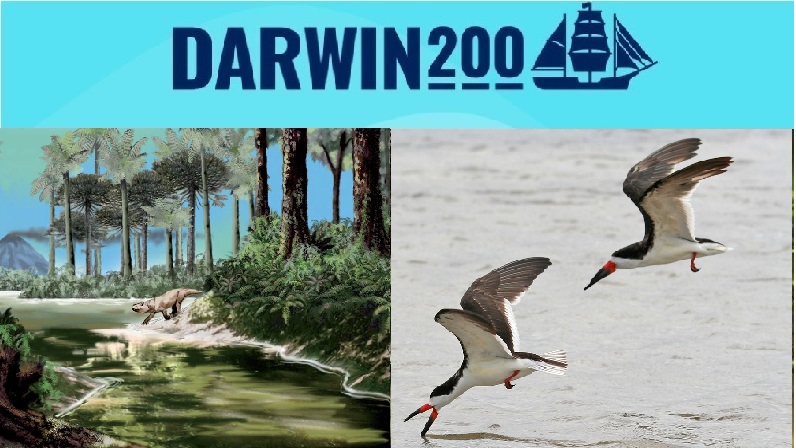
With the Humboldt Current at their backs, it is just three days’ sailing from Talcahuano to Valparaíso (‘Little San Francisco’), where the Ascensores (funicular railways and lifts) are now the principal form of public transport. Close to the high Andes, the Chilean coast is also flanked by very deep ocean trenches. Many seabirds, such as gulls and gannets, take advantage of the nutrient-rich current and gather on islands off the coast. In the past, these became covered in thick layers of concentrated bird droppings, or guano. From 1840 onwards, large European sailing ships came here to extract shiploads of guano for use as an indispensable agricultural fertiliser. Local workers toiled under appalling conditions, and the excavations caused severe disturbance to colonies of breeding seabirds. This situation came to an end through the exhaustion of guano reserves, the extraction of Chilean saltpetre in the Atacama Desert in northern Chile, and the rise of synthetic fertilisers. The coastal area near Valparaíso, such as the Estuario del Rio Maipo, is now a popular destination for birdwatchers seeking species such as the black skimmer (Rynchops niger, see photo), the Peruvian pelican (Pelecanus thagus) and the blackish oystercatcher (Haematopus ater).
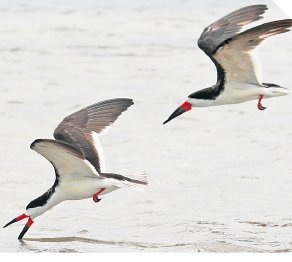
Black skimmers (Rynchops niger). Photo: Terry Foote, Wikipedia.

From 2023 to 2025, the Dutch sailing vessel the Oosterschelde is completing the Darwin200 Global Voyage in 32 legs, surveying the state of nature and the environment worldwide – nearly two centuries after Darwin’s own voyage around the world.
1834–1835
Rust over a week after his 26th birthday, Charles Darwin experiences ‘the most severe earthquake that the oldest inhabitant of the country can remember’ in the Chilean fortified city of Valdivia. ‘The earth, the very emblem of all that is solid, moves beneath our feet like a crust over a fluid’, he writes. He witnesses the enormous damage caused by the quake and the tsunami that follows two weeks later in the port of Talcahuano, near Concepción. ‘The whole coast was strewn with timber and furniture, as if a thousand great ships had been wrecked’, Darwin writes. ‘In Concepción each separate house (…) had become a heap of ruins (…); in Talcahuano, however (…), little more was to be seen than a layer of bricks, tiles and timber.’ He therefore considers the destruction of Concepción to be all the more ‘terrific’ and – ‘if I may use the expression’ – ‘picturesque’ (see drawing). His observations of volcanoes and earthquakes, and the discovery of fossil marine shells at 4,000 metres in the Andes (Revista de la Asociación Geológica Argentina, 2009), convince him that the uplift of rock (tectonics) is the result of ‘ordinary’ and long-lasting geological processes.
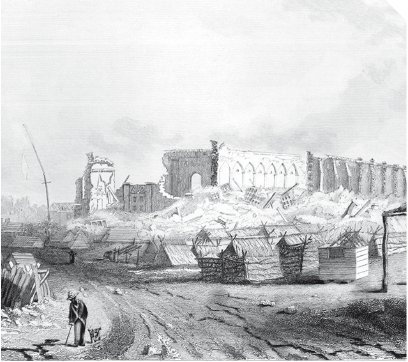
The ruins of the cathedral of Concepción after the 1835 earthquake, sketched by Beagle lieutenant John Clemens Wickham. Source: The Complete Work of Charles Darwin Online.
2024
On its way to Concepción, the Oosterschelde passes the near-peninsula of Chiloé, where Darwin carried out extensive fieldwork. This is still the home of the now-threatened Darwin’s frog (Bombinator darwinii, see photo) – a mouth-brooding species named after Darwin – and Darwin’s fox (Lycalopes fulvipes). Darwin himself collected the first specimen of this canid on the island of San Pedro by creeping up behind the animal and delivering a tap on the head with his geological hammer. At least 227 foxes still survive on the Chilean mainland and 412 on Chiloé, but these populations are threatened by forest fragmentation and feral dogs (IUCN Red List, 2016). The Oosterschelde sails past several colonies of penguins, seals and sea lions before completing this leg in the port of Concepción. This is the capital of the Biobío region, with extensive fishing, forestry and mining industries. The region takes its name from the Río Biobío, which flows into the Pacific Ocean near Concepción and is fed by the glacial lakes Laguna Icalma and Galletué in the Andes – lakes surrounded by temperate rainforest containing the extraordinary, evergreen monkey puzzle tree (Araucaria araucana ). Chile’s national tree, which graces – or disgraces – many a front garden here too.
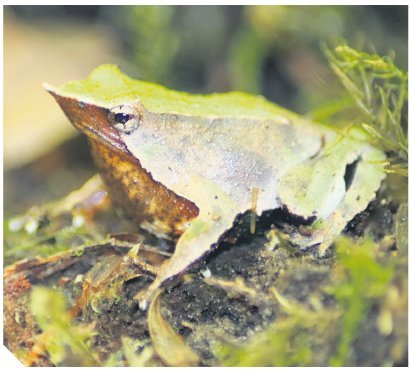
Darwin’s frog (Bombinator darwinii). Photo: Ong Ranita, Wikipedia.
From 2023 to 2025, the Dutch sailing vessel the Oosterschelde is completing the Darwin200 Global Voyage in 32 legs, surveying the state of nature and the environment worldwide – nearly two centuries after Darwin’s own voyage around the world.
1834
‘Never have I seen a more dismal prospect; the sombre, snow-speckled forests are barely visible through the misty air’, is how Charles Darwin describes the bay of Puerto del Hambre in Tierra del Fuego. In 1834 he visits Tierra del Fuego for the third time, and both the desolate landscape and the ‘naked savages’ in canoes (see image: painting by Conrad Martens) make an indelible impression on him. The same is true of the utterly failed ‘experiment’ to ‘reintroduce’ three previously kidnapped Fuegians of the Yaghan or Yámana tribe – o’rundel’lico (Jemmy Button), el’leparu (York Minster) and yok’cushly (Fuegia Basket) – and to convert and civilise their fellow tribespeople. It brings Darwin to the realisation of how thin and yet how decisive a veneer of culture can be. ‘Viewing such men, one can hardly make oneself believe they are fellow creatures and inhabitants of the same world’, he writes. ‘Nature, by making habit omnipotent and its effects hereditary, has fitted the Fuegian to the climate and the productions of his country.’ On 10 June 1834 the Beagle reaches the Pacific Ocean via the Strait of Magellan.
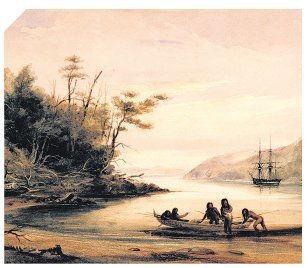
Fuegians in a canoe with HMS Beagle in the background at Tierra del Fuego. Painting: Conrad Martens, 1834 / National Maritime Museum, Greenwich, London.
2024
Of the original Fuegians, not one remains alive – partly as a result of a measles epidemic imported in 1883. On 16 February 2022, the last full-blooded descendant of the Yaghan tribe died: Cristina Calderón, aged 93, baptised by British missionaries, thanks to whom stories and a dictionary in her mother tongue have been preserved. In Tierra del Fuego, the Beagle Channel, the Darwin mountain range and Monte Fitz Roy serve as reminders of the British visitors of the 19th century. Punta Arenas is not far from the former settlement at Puerto del Hambre (Port Famine) that the Beagle visited, but was only founded in late 1848. The southernmost regional capital in Chile is now a base for tourists visiting the glaciers, lakes and fjords of Tierra del Fuego. The influence of climate change is making itself felt in the Cabo de Hornos Biosphere Reserve, designated by UNESCO in 2005, which is renowned for its remarkable mosses and the southernmost rainforests on Earth. Punta Arenas also offers an unexpected bonus: the crew and passengers of the three-masted schooner Oosterschelde can walk around without any risk of seasickness aboard the only full-scale replica of the two-masted brig Beagle (see photo) at the Museo Nao Victoria. Where a replica of the Victoria also lies – the ship with which Magellan became the first to sail around the world.
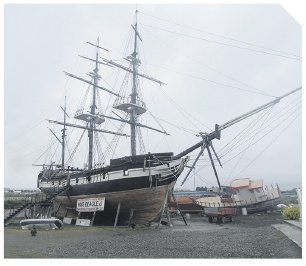
The full-scale replica of HMS Beagle at the Museo Nao Victoria near Punta Arenas. Photo: Amanderson2, Wikipedia.

From 2023 to 2025, the Dutch sailing vessel the Oosterschelde is completing the Darwin200 Global Voyage in 32 legs, surveying the state of nature and the environment worldwide – nearly two centuries after Darwin’s own voyage around the world.
1832–1834
Tween November 1832 and May 1834, the Beagle sails back and forth along the Patagonian coast several times for hydrographic surveys, and also visits the Islas Malvinas (Falkland Islands) twice in March. The British had only just taken possession of them, but to Darwin they make a ‘desolate and miserable impression’. There he also spots the only native mammal: the extremely tame and curious warrah, or Falkland wolf (Dusicyon australis). Darwin correctly predicts that this red fox will soon ‘be classed with the dodo, as an animal which has perished from the face of the earth’. He also notes that foxes on the western island ‘are smaller and redder in colour than those of the eastern island’, which must have contributed to his later insights into the evolution of island species through isolation. Just before rounding Cape Horn via the Strait of Magellan, the Beagle makes a ‘pit stop’ on 16 April 1834 at the mouth of the Río Santa Cruz in Patagonia to repair damage to the keel (see the iconic illustration by Conrad Martens). Beaching the ship at low tide Darwin calls ‘a ticklish operation’ for which ‘only one tide sufficed’ to carry out the repairs.
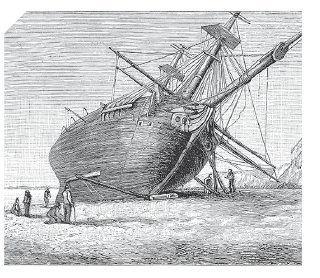
Keel inspection of HMS Beagle at the mouth of the Río Santa Cruz. Illustration: Thomas Landseer, after a sketch by Conrad Martens, 1839, British Library.
2023–2024
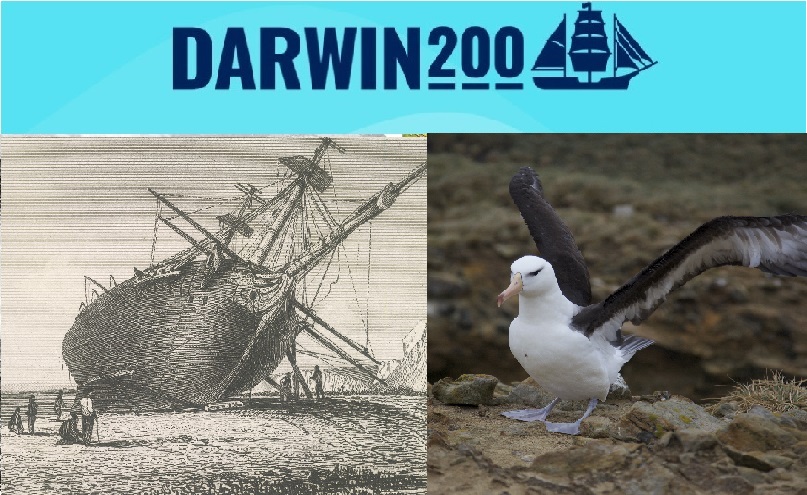
Departing for the Falkland Islands, the Oosterschelde will in all likelihood have a strong wind at her back. It is a remarkable destination, ‘not only because of its turbulent history, but also because of its overwhelming nature’, the sailing vessel’s website states. ‘The Falkland Islands are home to no fewer than five different species of penguin and the largest albatross colony in the world.’ The islands are expedition leader Stewart McPherson’s favourite destination, and they feature prominently in his 2016 documentary series Britain’s Treasure Islands. In addition to the common Magellanic penguin (Spheniscus magellanicus), there are also colonies of rockhopper penguins (Eudyptes chrysocome), macaroni penguins (E. chrysolophus), king penguins (Aptenodytes patagonicus) and gentoo penguins (Pygoscelis papua). The latter are the fastest-swimming penguins at 40 kilometres per hour, and owe their name to the braying sound they produce. The Falkland Islands also harbour large colonies of sea lions, fur seals and elephant seals, and are frequently visited by dolphins, whales and orcas. The islands are of great importance for the black-browed albatrosses that roam the Southern Hemisphere (see photo; first described in 1828 by the Dutch zoologist and Naturalis founder Coenraad Temminck as Thalassarche melanophris). Nearly two thirds of the more than six hundred thousand breeding pairs of black-browed albatrosses (Emu, 2007) breed on the Falkland Islands.
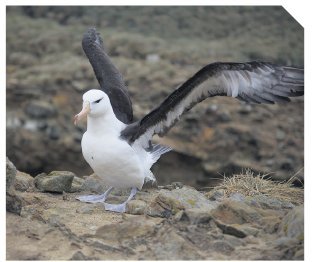
A black-browed albatross. Photo: Jason Auch, Wikipedia.
From 2023 to 2025, the Dutch sailing vessel the Oosterschelde is completing the Darwin200 Global Voyage in 32 legs, surveying the state of nature and the environment worldwide – nearly two centuries after Darwin’s own voyage around the world.
1832
‘I have just been sniffing the smell of some fossil bones of a Mammoth – what they are I do not know, but – move heaven and earth – they shall be mine’, Darwin writes about his discovery on 23 September 1832 of an enormous skull embedded in a cliff face near Punta Alta in Argentina. He spends three hours extracting the fossil from the rock and only returns to base after nightfall. It proves a fine investment of time, for the skeletal remains sent to England receive a rapturous reception. They are identified as the remains of a Megatherium (illustration: Memoir on the megatherium, Richard Owen, 1861), a giant ground sloth and the largest bipedal mammal ever to have walked the earth, and in 1833 they are exhibited at the meeting of the British Association for the Advancement of Science in Cambridge. ‘By sending home the coveted bones of Megatherium, your name is probably immortalised’, a friend writes to Darwin. Digitised 3D versions of these – and other spectacular fossils found by Darwin – can now be viewed on the website of the Natural History Museum in London.
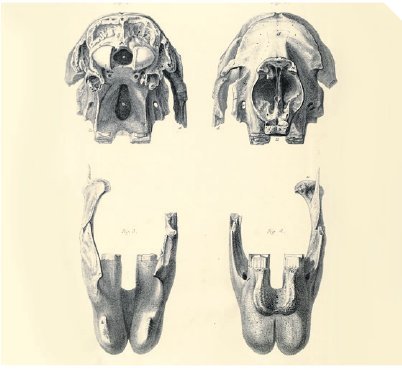
Skull and lower jaw of a giant ground sloth, or Megatherium. Illustration: Memoir on the megatherium, Richard Owen, 1861.
2023
Bahía Blanca – the simple crossing from Montevideo to Buenos Aires via Punta del Este – was originally scheduled as the seventh leg, but this has since been revised to a route ending at Puerto Madryn. Still a transition from Uruguay to Argentina, the Oosterschelde now sets course for Patagonia, the tail of South America that Magellan christened the ‘Land of the Big Feet’ (Patagão). Here the vessel battles against the powerful Falkland Current and the Pampero, the sudden south-westerly katabatic wind that sweeps down from the high plains. Along the coast, passengers can spot to their heart’s content the falcon-like southern crested caracara (Caracara plancus) and chimango caracaras (Milvago chimango). The waters around Puerto Madryn are also well known for their colonies of sea lions, elephant seals and penguins, but at this time of year above all as an area where southern right whales (Eubalaena australis, photo) calve. The whales give birth and nurse their young in the warmer waters of Golfo Nuevo and can be watched from the beach, or alternatively – as skeletons – in the modern Centro de Visitantes Istmo Ameghino or the historic Museo Provincial de Ciencias Naturales y Oceanografico in Puerto Madryn.
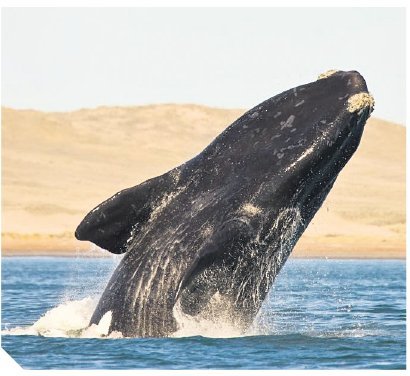
An imposing southern right whale (Eubalaena australis), a whale species that calves in the waters off Puerto Madryn. Photo: Secrets of Patagonia.
From 2023 to 2025, the Dutch sailing vessel the Oosterschelde is completing the Darwin200 Global Voyage in 32 legs, surveying the state of nature and the environment worldwide – nearly two centuries after Darwin’s own voyage around the world.
1832
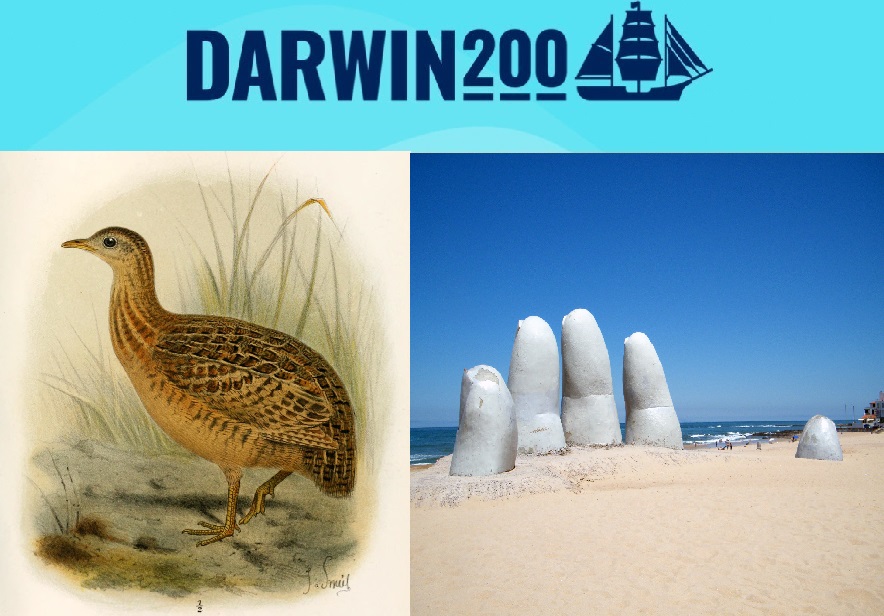
‘My companions were armed with pistols and sabres, a precaution that seemed to me unnecessary, but the first news we heard was that the day before a traveller from Montevideo had been found dead on the road with his throat cut’, reports Darwin, who stepped ashore at Montevideo on 26 July 1832. There the Beagle prepared to spend two years charting the south-eastern coast of the Americas, whilst Darwin ranged mainly overland and on horseback along the banks of the Río de la Plata. From Maldonado, now merged with the holiday resort of Punta del Este, he spent ten weeks shooting enthusiastically. In a single morning’s walk he collected eighty species of bird (‘many of them were singularly beautiful’). Of the ‘partridges’ – actually Nothuras from the tinamou family – Darwin noted that they ‘do not conceal themselves like the English species’. ‘It seems a very silly bird. A man on horseback, by riding round and round in a circle, or rather in a spire, can make them dizzy enough to knock on the head as many as he pleases.’ A Nothura species he collected later nonetheless bears his name: Nothura darwinii (see image).
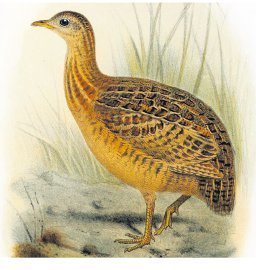
The Nothura darwinii, named after Darwin, from the tinamou family. Image: Joseph Smit, Catalogue of Birds, British Museum, 1895.

2023
In the leg from Rio de Janeiro to Punta del Este, the Oosterschelde leaves the tropics behind, and this is perceptible at sea. ‘The nights are cooler and the weather more unsettled’, warns the sailing vessel’s website. ‘South of the 35th parallel the wind becomes increasingly westerly, and to avoid drifting too far westward we stay close to the coast.’ Punta del Este is now a popular holiday resort in Uruguay, with sweeping sandy beaches and, on Playa Brava, the much-photographed sculpture by Chilean artist Mario Irarrázabal, La Mano (photo): four human fingers and a thumb tip protruding from the sand, a tribute to the drowning victim. A visit to the Lussich Arboretum in Maldonado also seems unmissable. Here the Uruguayan sailor and writer Antonio Lussich (1848–1928) began, some 125 years ago, to plant trees on uninhabitable land, including Tamarix (tamarisk), Eucalyptus and Acacia. His aim was to temper the harsh ocean wind and encourage birds to nest here. His legacy is a 182-hectare arboretum containing four hundred exotic and seventy endemic tree species, and now one of the most important forest reserves in the world.
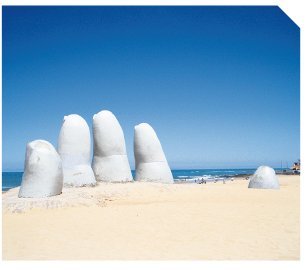
The sculpture La Mano on Playa Brava by Chilean artist Mario Irarrázabal. Photo: Coolceasar, Wikipedia.
From 2023 to 2025, the Dutch sailing vessel the Oosterschelde is completing the Darwin200 Global Voyage in 32 legs, surveying the state of nature and the environment worldwide – nearly two centuries after Darwin’s own voyage around the world.
1832
‘The air and calm waters of the bay vied with each other in beauty’ and ‘we entered a forest which in the grandeur of all its parts could not be exceeded’, writes Charles Darwin about Rio de Janeiro. He spends three months there and visits several plantations on horseback, where he is astonished by the living and eating habits he observes and frankly appalled by the ‘blind selfishness’ of slavery. For most of his stay he lives in a house on the bay of Botafogo at the foot of the Corcovado, whose summit was not yet crowned by the statue of Christ Cristo Redentor (see: View of Rio from the Corcovado by Beagle artist Augustus Earle). On forested slopes he finds no fewer than eight species of flatworm (Planaria) that ‘feed on rotten wood’. Darwin also discovers a Hymenophallus, a stinkhorn fungus that attracts beetles with its unpleasant odour. This leads him to the following reflection on plant–animal relationships: ‘When man introduces a new species into a country, the relationship is often disrupted. As an example of this I may mention that cabbage and lettuce leaves, which in England are devoured by so many slugs, remain untouched in the kitchen gardens near Rio.’
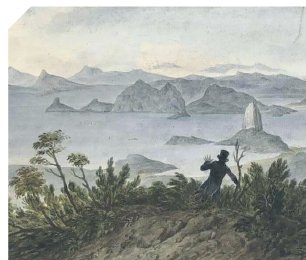
View of Rio from the Corcovado by Beagle artist Augustus Earle. Source: National Library of Australia.
2023
Darwin was the last to document the presence of howler monkeys in Rio de Janeiro, but since 2015 four brown howler monkeys (Alouatta guariba) have been reintroduced into Tijuca National Park, which also encompasses the Corcovado. This has previously been achieved for the native Central American agouti Dasyprocta punctata, and there are also plans to reintroduce kinkajous , sloths, and the endangered golden lion tamarin (Leontopithecus rosalia, photo). This species has lost more than 95 per cent of its original rainforest habitat in Brazil, and the Darwin200 team is following the efforts of the Associação Mico-Leão-Dourado (AMLD, micoleao.org.br) to save the golden lion tamarin from extinction. Wild population numbers rose again over thirty years from around 600 to 3,700, until in 2017 yellow fever reduced the population by a third once more. AMLD is therefore now deploying a specially developed vaccine – a rare example of vaccination of wild animals. Tip: on 12 November a Darwin Day event in Rio focused on reforestation, featuring botanist, Darwin200 patron and great-great-granddaughter Sarah Darwin, can be followed via the Darwin200 YouTube channel.
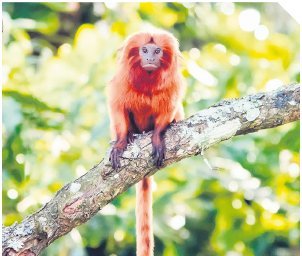
A golden lion tamarin (Leontopithecus rosalia). Photo: Associação Mico Leão Dourado.
From 2023 to 2025, the Dutch sailing vessel the Oosterschelde is completing the Darwin200 Global Voyage in 32 legs, surveying the state of nature and the environment worldwide – nearly two centuries after Darwin’s own voyage around the world.
1832
‘It was a most delightful day. Delight itself, however, is a weak term to express the feelings of a naturalist who, for the first time, has wandered by himself in a Brazilian forest’, writes Charles Darwin about his first excursion onto the South American mainland. ‘The elegance of the grasses, the novelty of the parasitical plants, the beauty of the flowers, the glossy green of the foliage, all tended to make a scene of surpassing beauty. (…) The noise of the insects is so loud that it may be heard even in a vessel anchored several hundred metres from the shore, and yet within the recesses of the forest a universal silence appears to reign.’
In Salvador (see the illustration by voyage painter Augustus Earle), he enters into his first heated argument with Captain FitzRoy over the injustice of slavery, very nearly getting himself put off the ship. An important observation Darwin makes on the coast concerns the bridled burrfish Diodon antennatus (now: Chilomycterus antennatus). He notes that even when inflated it can swim well, though owing to its altered buoyancy the fish floats ‘upside down’.
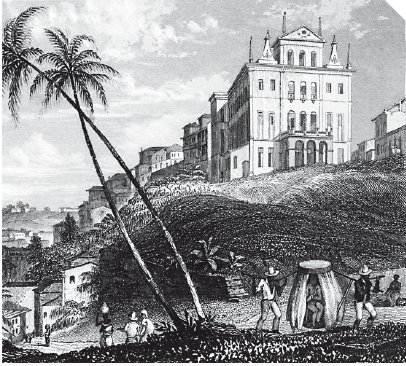
Tail statue of San Salvador. Detail from the illustration by voyage painter Augustus Earle, 1832.
2023
Near Salvador da Bahía, the Darwin200 team once again joins forces with the NGO Tamar – from Tartarugas Marinhas (sea turtles) – which protects nesting areas of loggerhead sea turtles (Caretta caretta) and olive ridley sea turtles (Lepidochelys olivacea) in the area. Salvador lies on the peninsula of Baía de Todos os Santos, fringed by mangrove forests. These are threatened by urban expansion and the establishment of aquaculture operations, including shrimp farms. In 2019, a leaking tanker carrying crude oil from Venezuela caused a massive environmental disaster off the Brazilian coast. The consequences for this vulnerable area are being studied, among others, by the Universidade Federal da Bahia. In addition, conservationists are working on mangrove replanting. In Brazil, mangroves were legally designated as permanent protection zones in 2002. Former Brazilian president Bolsonaro’s attempt to revoke this protection was blocked by a federal judge in 2020. Around Salvador da Bahía lies an ecozone of two thousand square kilometres containing red mangrove (see photo), black mangrove, and white mangrove, providing habitat for many juvenile fish, crustaceans, sea turtles, and birds.
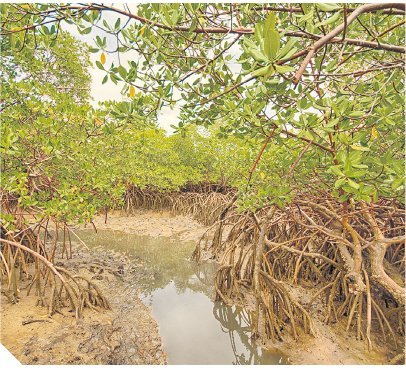
Red mangrove (Rhizophora mangle). Photo: Ricardo Solar, One Earth.
From 2023 to 2025, the Dutch sailing vessel Oosterschelde is sailing the Darwin200 Global Voyage in 32 legs, to take stock of the state of nature and the environment worldwide, nearly two centuries after Darwin’s voyage around the world.
1832
‘Darwin, who had just turned 23, spent on 20 February ‘a most delightful day’ wandering through the forest on the main island of Fernando de Noronha, part of the small volcanic archipelago of the same name. ‘The whole island is one forest, and this is so entangled that it requires great exertion to crawl through it’, Darwin wrote, noting the presence of magnolias, laurel shrubs, and trees bearing delicate foxglove-like flowers. Despite his very brief visit and account, Darwin here describes a situation that would soon be lost.
The remote island was already being used as a penal colony at the time, and – to prevent prisoners from escaping on home-made rafts – was almost entirely deforested later in the nineteenth century. The vegetation on the island, two-thirds of which has been a national park since 1988, is still in the process of recovering. A remarkable leguminous ‘coral tree’ that Darwin may well have spotted is the mulungu (Erythrina velutina). It flowers briefly and on this island is pollinated by three endemic birds – the Noronha dove (Zenaida auriculata noronha), the Noronha vireo (Vireo gracilirostris), and the Noronha elaenia (Elaenia ridleyana) – and by the native Noronha skink (Trachylepis atlantica, see photo).
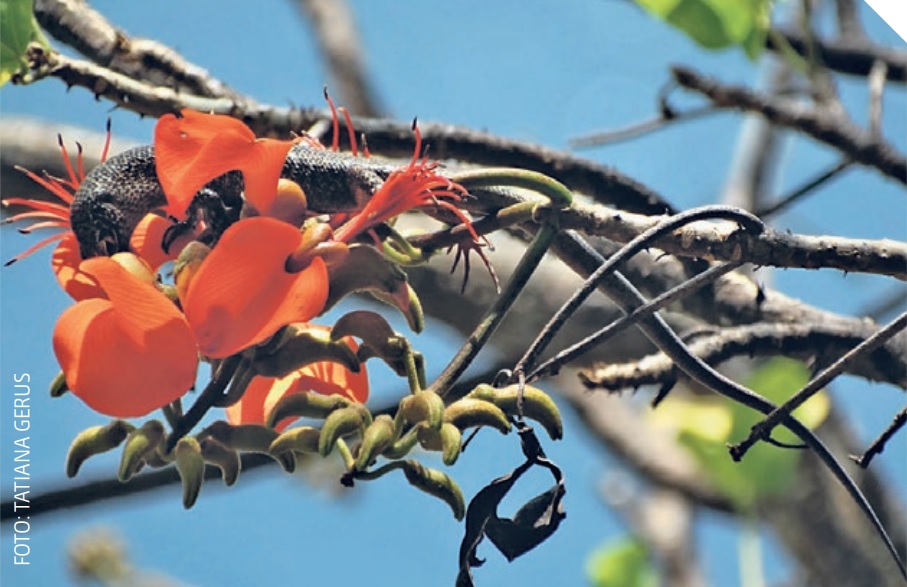
A Noronha skink (Trachylepis atlantica) pollinating a flower of the mulungu coral tree (Erythrina velutina). Photo: Tatiana Gerus.

2023
Hrazilian Fernando de Noronha is now a paradise destination for divers, snorkellers and tourists. The archipelago and coral island Atol das Rocas were inscribed on the UNESCO World Heritage List in 2001. The surrounding waters are important spawning and feeding grounds for tunas, sharks, turtles and marine mammals, and the islands support the largest concentration of tropical seabirds in the western Atlantic Ocean. The Darwin200 team visits the Projecto Golfinho Rotador project, dedicated to the acrobatic spinner dolphin (Stenella longirostris), as well as projects focused on sharks, reef fish, coral reefs and octopuses.
The island of Fernando de Noronha itself faces problems above all from invasive species, including considerable trouble caused by the black-and-white tegu (Salvator merianae), which was deliberately introduced in the 1950s to control invasive rats. This diurnal lizard, which can reach up to 1.5 metres in length, turned its attention not so much to the nocturnal rats but instead preys on the eggs (see photo) and chicks of seabirds, and on newly hatched sea turtles on beaches. The NGO Tamar – from Tartarugas Marinhas (sea turtles) – works to protect these breeding grounds.
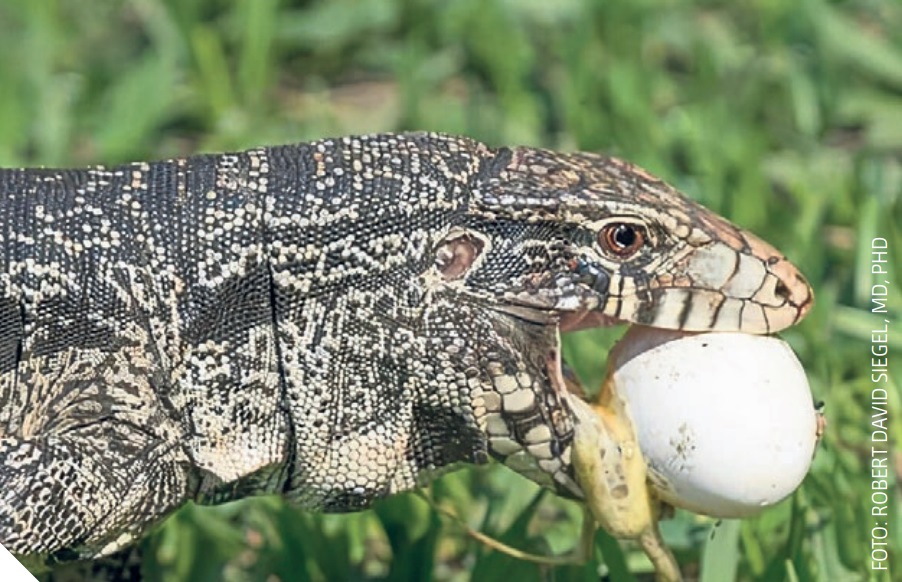
The invasive black-and-white tegu (Salvator merianae) is a formidable predator of seabird and turtle eggs. Photo: Robert David Siegel, MD, PhD
From 2023 to 2025, the Dutch sailing vessel Oosterschelde is sailing the Darwin200 Global Voyage in 32 legs, taking stock of the state of nature and the environment worldwide, nearly two centuries after Darwin’s voyage around the world.
1832
‘A child with a new toy could not have been more delighted’, wrote Beagle captain Robert FitzRoy of Charles Darwin’s first excursion on a tropical island. On 16 January 1832 he went ashore at the port town of Praia on the Cape Verdean island of Santiago (then: St. Jago) and during his 21-day visit made extensive notes above all on the geology of the island, as ‘the most interesting part of its natural history’.
The encounter in Cape Verde that made the greatest impression on him was with a constantly colour-changing octopus in a tidal pool. ‘This cuttlefish displayed its chameleon-like power both whilst swimming and whilst stationary at the bottom. I was much amused at the various means by which one of these animals endeavoured to avoid discovery – the creature seemed perfectly aware that I was watching it’, wrote Darwin. An octopus – possibly the specimen now held in the collection of the Natural History Museum in London (photo) – later turned out to squirt a jet of water at him from a pool.
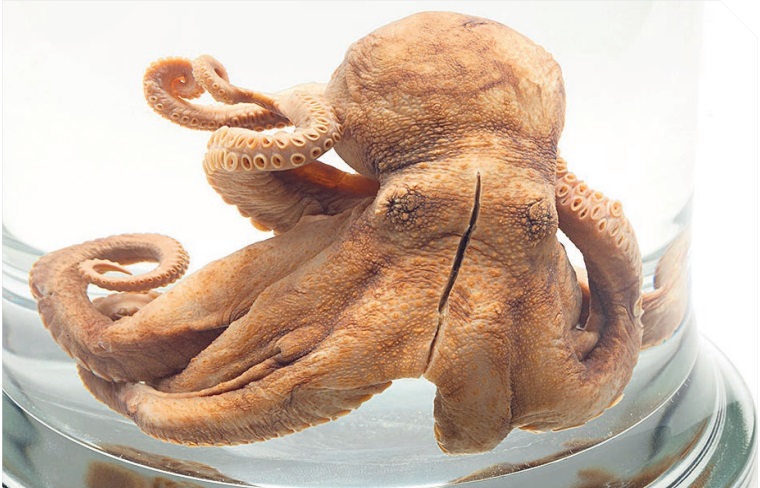
The octopus (Octopus vulgaris) collected by Darwin in 1832 on Cape Verde. Photo: Natural History Museum, London.
2023
Het Darwin200 team visits projects run by the Cape Verdean NGOs Biosfera and TerriMar on and around the windward islands of Saõ Vicente and Santo Antão. Alongside projects on endemic flora and the impact of fishing and tourism on sharks, rays and sea turtles, attention is also given to the unique endemic birds of Cape Verde. There appears to have been a successful reintroduction of the Raso lark (Alauda razae) on the uninhabited volcanic island of Santa Luzia, using larks from the tiny islet of Razo, where the species had managed to survive. Nearby Santa Luzia has been cleared of cats and rats, and in 2020 researchers counted nine nests and fifty Raso larks there.
The celebrated British bird illustrator John Gerrard Keulemans (1842–1912), born in Rotterdam, portrayed the Raso lark in 1898 (see illustration). Keulemans went on expedition to West Africa for the National Museum of Natural History in Leiden (now: Naturalis) and in 1866 was the first to describe the Cape Verde sedge warbler (Acrocephalus brevipennis), an iconic endemic species that until 2012 adorned the 1,000-escudo banknote of Cape Verde.
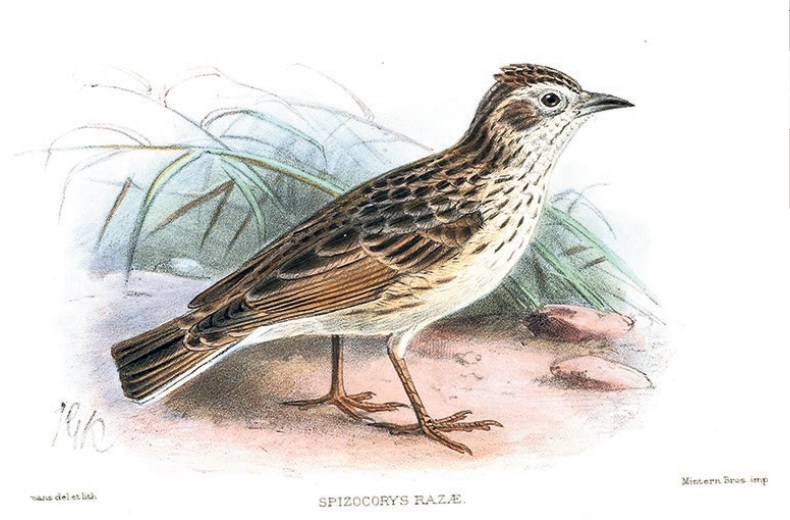
The Raso lark (Alauda razae) portrayed by the British bird illustrator John Gerrard Keulemans (1842–1912). Source: Ibis, 1898 / Wikipedia

From 2023 to 2025, the Dutch sailing vessel Oosterschelde is sailing the Darwin200 Global Voyage in 32 legs, to take stock of the state of nature and the environment worldwide, nearly two centuries after Darwin’s voyage around the world.
1832
Tenerife perhaps dealt Darwin the greatest disappointment of his nearly five-year voyage on the Beagle. As a student in Cambridge he had already tried to organise an expedition to this Canary Island in order to climb the volcano El Teide and set eyes on Alexander von Humboldt‘s El Drago Milenario, following in the footsteps of his hero. According to Von Humboldt, such enormous dragon trees (Dracaena draco, illustration) could live for more than a thousand years. When the perpetually seasick Darwin arrived with the Beagle in the harbour of Santa Cruz on Tenerife on 6 January 1832, Captain Robert FitzRoy received word that they would have to spend twelve days in quarantine owing to a cholera outbreak in England. FitzRoy promptly weighed anchor and set course for Cape Verde. According to FitzRoy it was a ‘true calamity’ for Darwin – though scant consolation perhaps is the fact that dragon trees are considerably less than a thousand years old. It is in fact the Canary Islands juniper (Juniperus cedrus), on a steep slope of El Teide, that at 1,481 years old is the oldest tree on Tenerife and in the European Union (The Scientific Naturalist, 2022).
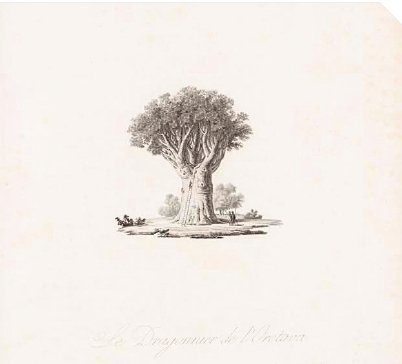
The dragon tree (Dracaena draco) on the frontispiece of Le Dragonnier de l’Orotava by Alexander von Humboldt and Aimé Bonpland. Source: Le dragonnier de l’Orotava, 1810.
2023
Today, tourism – with six million visitors per year – and sometimes illegal construction practices pose a major threat to nature on Tenerife, notes geologist Jaime Coello Bravo, director of the foundation Telesforo Bravo Juan Coello, named after two celebrated volcanologists. Concrete structures along the coast cause fragmentation of natural areas, with noise and light pollution as additional consequences. The Darwin200 project also draws attention to the plant life on El Teide, which is increasingly moving to higher altitudes due to warming, and to the impact of drought caused by water extraction on the endemic and near-extinct blue chaffinch (Fringilla teydea) and the Canarian subspecies of the great spotted woodpecker (Dendrocopos major canariensis). Meanwhile, in the coastal waters of Tenerife, it is above all the growing popularity of dolphin and whale watching among tourists that is causing considerable concern. One popular marine mammal ‘hunted’ by tourists around the Canary Islands is the short-finned pilot whale (Globicephala macrorhynchus, photo), which, with more than four hundred identified individuals, forms one of the few resident pilot whale populations in the world. Mass tourism causes disturbance and may threaten the survival of this unique population.
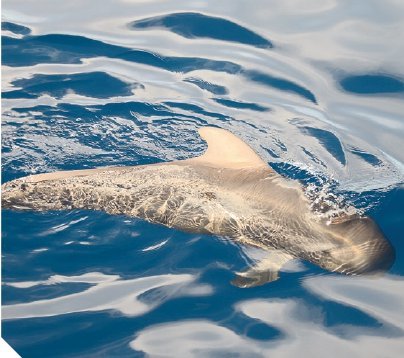
The short-finned pilot whale (Globicephala macrorhynchus), with its distinctive bulbous forehead, is a permanent resident of the waters around the Canary Islands. Photo: Cayambe, Wikipedia.
See also:
–Darwin200 website
–Sailing schedule Oosterschelde
–Track the ship
–Darwin200 voyage log
–‘We are creating the world’s most exciting classroom’ – Bionieuws, 2 July 2022)
–The ship Oosterschelde sails in Darwin’s wake for two years – AD, 3 August 2023
–‘Don’t let the Galápagos go the way of Hawaii’ – Bionieuws, 13 September 2024)
–‘We are bringing incredible young conservationists from different parts of the world to the ports that Charles Darwin visited’ – SBS Nederland, 19 November 2024
–Climate research in the wake of HMS Beagle: Charles Darwin’s voyage completed once more – de Volkskrant, 18 July 2025
–Darwin-inspired global voyage ends in Falmouth – BBC News, 20 July 2025