


Eric Eversdijk, a relationship manager at Rijkswaterstaat Zee en Delta in Goes, proudly poses for a photo with the first starry smooth-hound he caught during Sharkatag 2025. Photo: Moebius
The Wadden Sea and Eastern Scheldt turn out to be nurseries for cartilaginous fish. Bionieuws joined the fishing on Sharkatag 2025 and witnessed how some sharks and rays are making a comeback.
‘A wave of pure joy washed over me. I never expected to experience anything like this.’ With a degree of self-deprecating humour, Eric Eversdijk goes through the formalities surrounding his first. The relationship manager at Rijkswaterstaat Zee en Delta in Goes is the first to hook a sizeable starry smooth-hound (Mustelus asterias) on 9 July during Sharkatag 2025, on board the sport-fishing vessel Barracuda. Skipper Jack assists deftly with bringing the shark aboard, unhooking it in a flash and measuring it. Eversdijk then poses for a photo with his proud catch: a female measuring 85 centimetres. The shark is quickly returned overboard, swims briefly at the surface and then dives under. A scene that repeats itself twelve times that morning on the Barracuda: eight adult females, two males and two shark pups. Only the pups are now tagged, by pinning a small floy tag near the dorsal fin.
Only the pups are now tagged, by pinning a small floy tag near the dorsal fin
The three-day Sharkatag event is a collaboration between Sportvisserij Nederland and the Nederlandse Charterboot Vereniging. ‘We have been fishing for sharks for about fifteen years now. Not just for the pleasure of sport fishing, but also because it yields valuable information about the migration, growth and reproduction of starry smooth-hounds’, says Niels Brevé, head of knowledge and research at Sportvisserij Nederland and researcher at Wageningen University & Research. ‘Don’t be alarmed – this shark species doesn’t bite. They only have blunt, flat little teeth.’ In the outer harbour on the working island of Neeltje Jans, near the storm surge barrier in the Eastern Scheldt, around ten fishing boats are ready to head out into the North Sea. Each carries some eight to ten participants, who on this VIP day include politicians, policymakers, administrators and a journalist.
Prawn
Barracuda skipper Jack sets up rods with line, weights and hooks on board. For the first round he even baits the hook with a prawn before casting the lines. ‘Give a little extra line so the bait lies right on the bottom’, is his advice. ‘The rod sits in a holder, so have a drink and don’t worry – absolutely anyone can bring in a starry smooth-hound.’ The Facebook and Instagram pages of charter boats bear him out: they are full of portraits of anglers of all ages proudly holding a shark.
Catch rate
‘The catch rate here has increased enormously. Fifteen years ago you were happy if you caught fifty sharks in a year, and now you can catch fifty in a single day per boat. Things seem to be going well for the starry smooth-hound here, but the question remains whether that translates to the population as a whole. It is listed as near threatened on the red list’, says Brevé. According to him, there is growing evidence that this viviparous shark species uses the Eastern Scheldt as a nursery and the outer delta as a spawning ground. Analyses of tagged and recaptured sharks from the Sharkatag project established five years ago that male and female sharks of all sizes congregate in the Zeeland Delta in spring and summer (Journal of Fish Biology, 2020). ‘In winter, the largest females move southward through the Channel as far as Brittany and even the Bay of Biscay, whilst the large males head northward’, says Brevé. ‘By now some 5,500 sharks have been tagged, and we are focusing our research solely on the very smallest, newly born young and the very largest, adult breeding individuals. Since 2020 we have therefore only been tagging specimens smaller than 35 centimetres and larger than 110 centimetres. The evidence for a nursery is mounting: around 95 per cent of the specimens we catch in the Eastern Scheldt are large females of more than 84 centimetres, and it is the only place where we catch tiny pups – newborn sharks. Spawning is harder to prove because female sharks can store sperm and fertilise themselves at a later stage. We do regularly see mating pairs swimming at the surface, but they are difficult to sample.’

Strong evidence that the Eastern Scheldt is a shark nursery is ‘demonstrated’ by the capture of this 21.5-centimetre pup of a starry smooth-hound. PHOTO: NIELS BREVÉ, SPORTVISSERIJ NEDERLAND/WUR
Because sport anglers here release virtually all their catches immediately, this poses no threat to the population, according to Brevé. ‘And West European commercial fishers do not target starry smooth-hounds and land very few of them. You can eat them, if you know how to prepare them. If you don’t do it properly, they start to smell of urea – which is why they’re sometimes called piss sharks. Apparently you can already buy three of them here for a euro. In countries around the Mediterranean the situation is different: there they are specifically targeted.’ They appear on menus as emissole or saumonette. Brevé: ‘You wouldn’t want someone getting the ill-fated idea of netting sharks in the Eastern Scheldt – the nets would end up crammed with pregnant sharks that spontaneously give birth to premature pups. A disaster! Because the Eastern Scheldt has a great deal of seaweed growth, and this weed gets tangled up in mussel fishing gear, netting is difficult there. But it’s also something you really wouldn’t want in the outer delta. In a single trawl you could easily remove a hundred to a thousand sharks. That would be over very quickly’, Brevé believes. He is working with colleagues on a publication that identifies the Eastern Scheldt as an important nursery area and the outer delta as a possible spawning ground for the starry smooth-hound. ‘With that, we may be able to enforce a mandatory catch-and-release rule and a periodic fishing ban, and make the Eastern Scheldt a safe haven for this shark.’
Nursery function
Paddy Walker, an expert in cartilaginous fish, director of the Dutch Elasmobranch Association (NEV) and lecturer at Van Hall Larenstein University of Applied Sciences, is also convinced of the Eastern Scheldt’s nursery function. ‘Both the starry smooth-hound and the common stingray almost certainly give birth to their young in the Eastern Scheldt, and for the nursehound we suspect that both the Eastern Scheldt and the Wadden Sea serve as nurseries’, says Walker. ‘The nursehound was once a common species in the North Sea, but is now listed as critically endangered on the red list.’ Live-bearing sharks and rays are particularly vulnerable to overexploitation: they are long-lived, reproduce slowly, and produce few offspring. ‘Evolutionarily, cartilaginous fish are a highly successful group and have inhabited the seas for nearly 450 million years, but they are vulnerable to rapid changes in their environment. In that respect they resemble marine mammals more than fish.’
The future of cartilaginous fish
‘Globally, there are still many threats facing sharks and rays, but the North Sea shows that with sound policy, management and protection, positive steps can be taken’, says Paddy Walker, director of the Dutch Elasmobranch Association (NEV). The association was co-founded in 2010 to fill the large gaps in knowledge about cartilaginous fish. ‘Without knowledge, good management and conservation are not possible, but without a foothold in policy, knowledge cannot be put to use. You need targeted research, but you also have to translate the knowledge gained into achievable actions and practical steps. And you also have to contend with existing business models’, says Walker. ‘Fisheries and bycatch are a reality. Sometimes it is therefore better, for example, to focus on obtaining exemptions from the landing obligation and on promoting reduced bycatch and the rapid release of sharks and rays.’ The NEV has actively contributed to the implementation of the European Marine Strategy Framework Directive (2008), the drafting of the Dutch Shark Action Plan (2015–2021) and its successor: the Shark and Ray Action Plan (2022–2027). In its fifteenth anniversary year, the association is organising the annual European Elasmobranch Association conference at Diergaarde Blijdorp Rotterdam from 29 to 31 October. Walker: ‘Under the title Tomorrow’s World, it looks ahead to the future of sharks and rays – and for the North Sea that future is not without concerns, but it is hopeful.’
Sharks and rays in the Netherlands
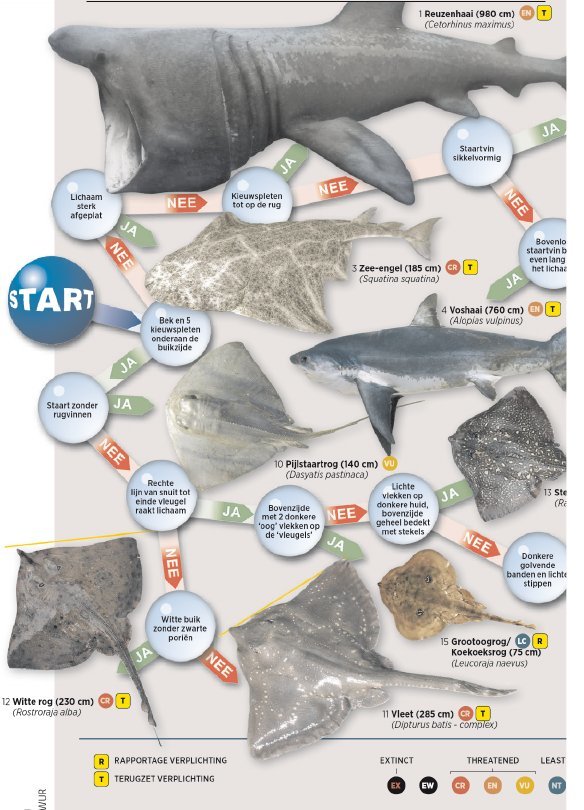
PHOTO: NIELS BREVÉ, SPORTVISSERIJ NEDERLAND/WUR PHOTO: MOEBIUS
The chance of encountering a great white shark (Carcharodon carcharias) Carcharodon carcharias in the North Sea today is vanishingly small. This largest predatory fish in the world served as the model for the cult film Jaws (Steven Spielberg, 1975) fifty years ago. Yet the great white was, not so long ago – during the last Eemian interglacial and early Holocene (130,000 to 110,000 years ago) – at the very least a regular visitor to the North Sea, as evidenced by beach finds of at least 491 fossil teeth at 13 locations in North and South Holland (journal Afzettingen, 2021). No historical records of the great white shark are known, but for some eight shark and eight ray species the North Sea remains a natural part of their range. In the nineteenth century, Dutch fishermen still targeted rays and sharks in the North Sea, Wadden Sea and Zuiderzee. The thornback ray (Raja clavata), common skate (Dipturus batis), spurdog (Squalus acanthias) and tope (Galeorhinus galeus) were common species at the time, but dramatic population declines during the twentieth century meant that virtually all targeted fishing for these cartilaginous fish ceased. The intensive bottom trawling for flatfish such as common sole and European plaice in the previous century was particularly responsible for the decline of shark and ray species, though the loss of nursery habitat in the Zuiderzee and a lack of suitable spawning grounds in Dutch coastal waters probably also played a role. Sharks and rays are now regarded primarily as difficult-to-avoid bycatch. Three ray species – the thornback ray, spotted ray (Raja montagui) and blonde ray (Raja brachyura) – are landed at fish auctions and are subject to a Brussels quota. No quotas apply to landed sharks, but in the Netherlands these are auctioned off at very low prices.
 Excerpts from the leaflet Sharks in the North Sea produced by the Dutch Elasmobranch Association. Source: NEV website.
The spurdog was the most common shark species in the North Sea until the 1970s, but proved highly vulnerable to overexploitation. The small-spotted catshark (Scyliorhinus canicula), best known from stranded egg cases, is doing well. Meanwhile, the smoothhound sharks (Mustelus mustelus and M. asterias) appear to be recovering. The large, cosmopolitan, free-swimming, fish-eating porbeagle (Lamna nasus) and common thresher (Alopias vulpinus) are at most seen sporadically in Dutch coastal waters. The same applies to the basking shark (Cetorhinus maximus), which sometimes swims slowly at the sea surface filtering plankton and, at up to eleven metres in length, is the second-largest shark in the world.
The enormous common skate, Europe’s largest ray species, was once an icon of the North Sea and was actively fished, but is now virtually extinct here and persists only in small populations off northern Scotland. In the southern Dutch coastal waters, the common stingray (Dasyatis pastinaca) is now the largest ray species, caught in small numbers off Zeeland during the summer and spotted as recently as 30 June near the Zeelandbrug by divers.
Excerpt from the new identification card Sharks, Skates & Rays, made freely available to fishermen to prevent protected sharks and rays from being landed.