


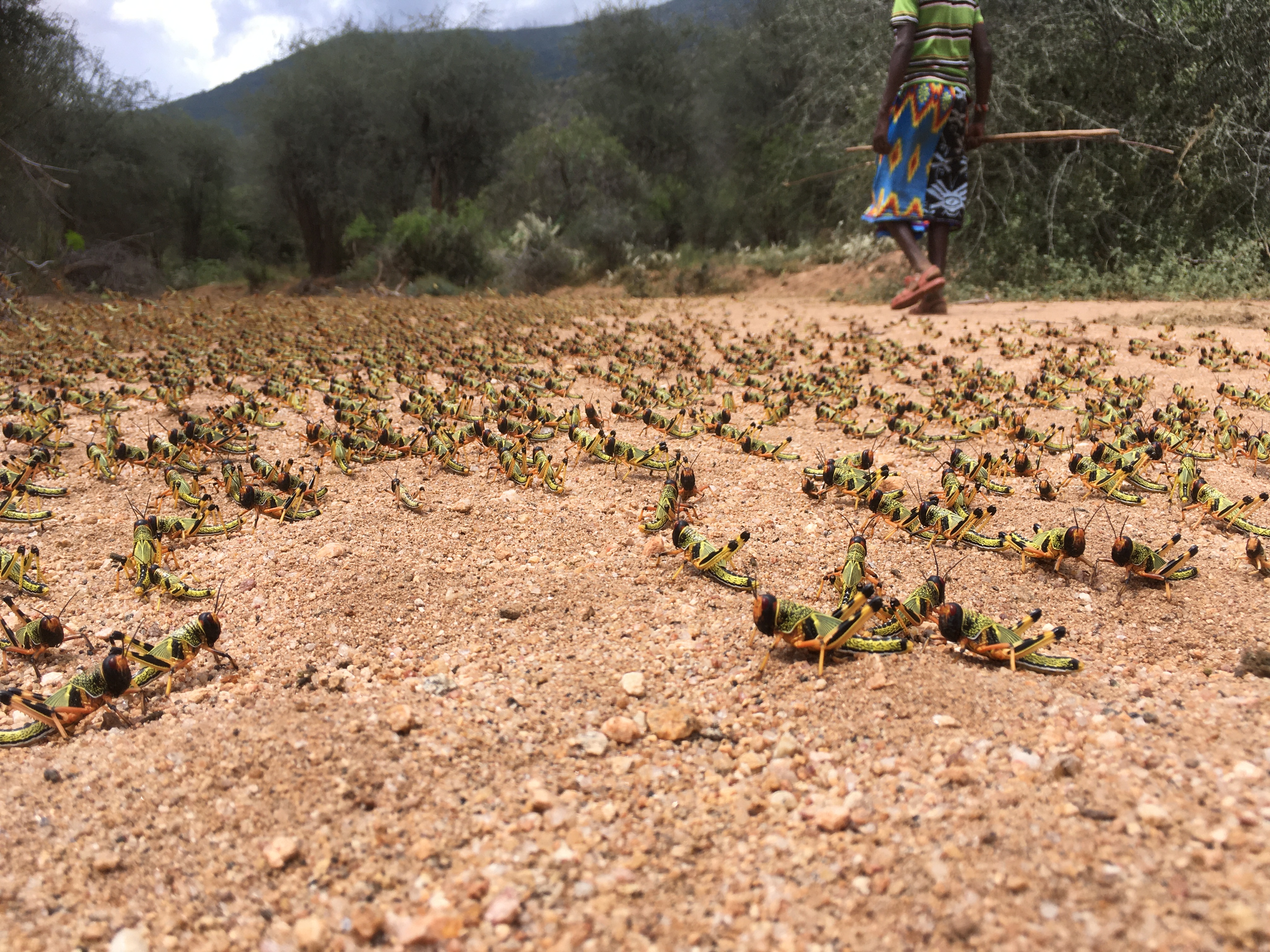
 A swarm of desert locusts in East Africa. Photo: © Einat Couzin-Fuchs, Inga Petelski, Yannick Günzel & Felix B. Oberhauser.
Swarming behaviour in locusts cannot be fully explained by physical models of self-organisation. Virtual reality research shows that a minimal cognitive framework is required.
Classical models of collective behaviour fail to explain how desert locusts march together and form swarms that threaten the livelihoods of millions of people. ‘In contrast to the assumptions of these models, locusts do not explicitly align with their neighbours’, writes an international research group led by behavioural biologist Iain Couzin of the Max Planck Institute of Animal Behavior in Konstanz (Science, 28 February). Using field, laboratory and virtual reality experiments with African desert locusts (Schistocerca gregaria), they show that self-organising particle models from physics cannot account for the emergence of swarming behaviour, and that a minimal cognitive framework is required instead. In this framework, each individual locust makes directional choices based on its own internal consensus. ‘Our findings challenge long-held beliefs about how order emerges from disorder in collective animal behaviour’, the researchers write.
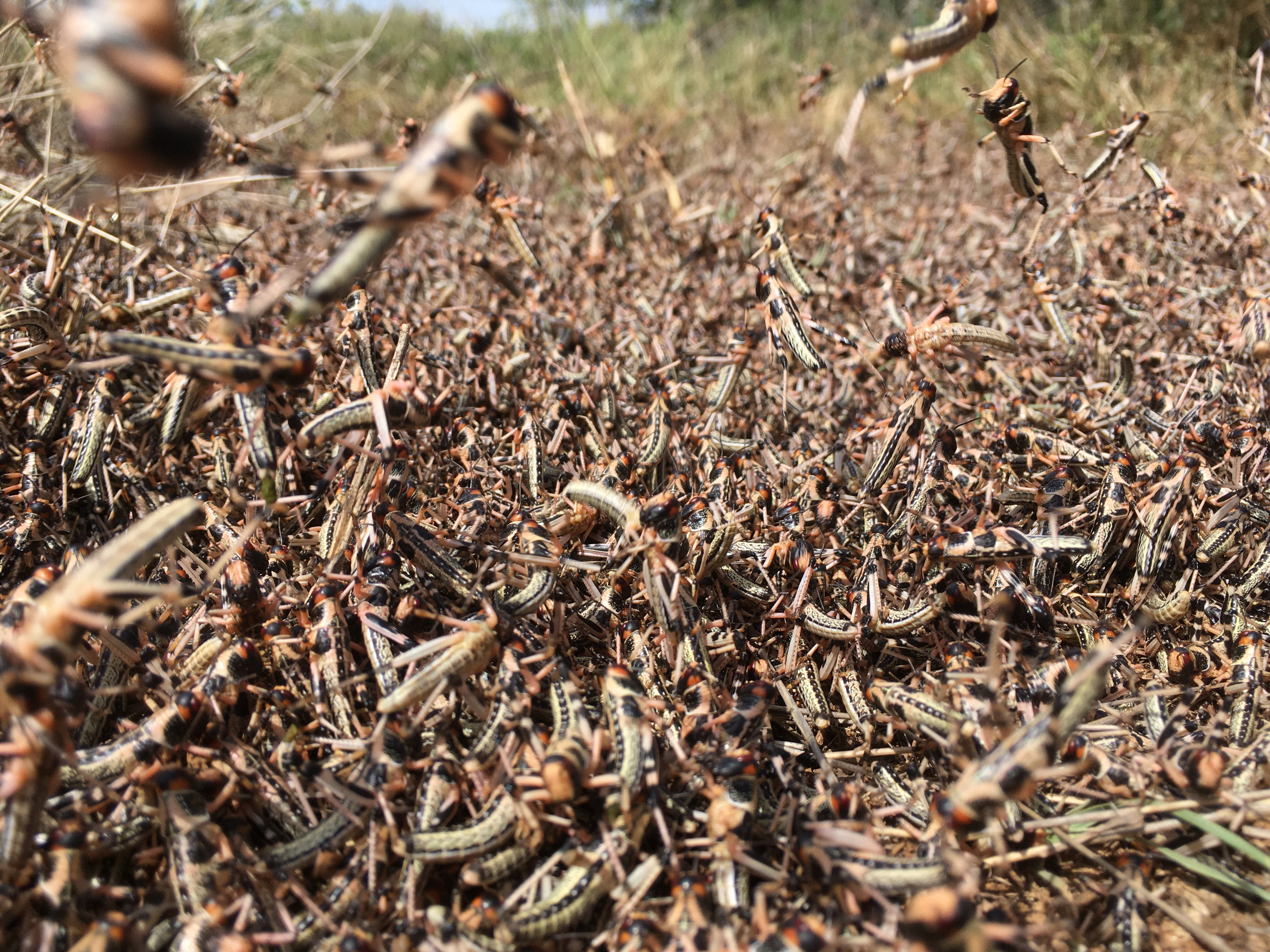 The swarming behaviour of desert locusts under natural conditions in East Africa is highly complex. Photo: © Einat Couzin-Fuchs, Inga Petelski, Yannick Günzel & Felix B. Oberhauser.
The formation of swarms by desert locusts – which in North Africa can sometimes cover enormous areas with billions of individuals – is one of the most spectacular and destructive forms of collective movement in nature. Such a swarm begins when young locust nymphs start marching together, flowing like a river and consuming all vegetation in their path, before moulting into swarms of winged adults.
Particle physics
Traditional models based on particle physics describe swarming behaviour by assuming fixed rules for interactions between individuals. These individuals then align with their moving neighbours in a consistent manner, causing the density of a swarm to increase or decrease according to a predictable pattern. Such models do not, however, tally with the behaviour that desert locusts display in an ingenious virtual reality setup. In this setup, locust nymphs move freely on a rotating sphere whilst being immersed in a panoramic three-dimensional virtual projection featuring realistic simulations of other locusts. Rather than following fixed behavioural rules, they follow a minimal cognitive framework in which they determine their own direction independently. The researchers also find, upon reanalysis, no evidence of a density threshold for coordinated collective movement in experiments with marching locusts in an arena.
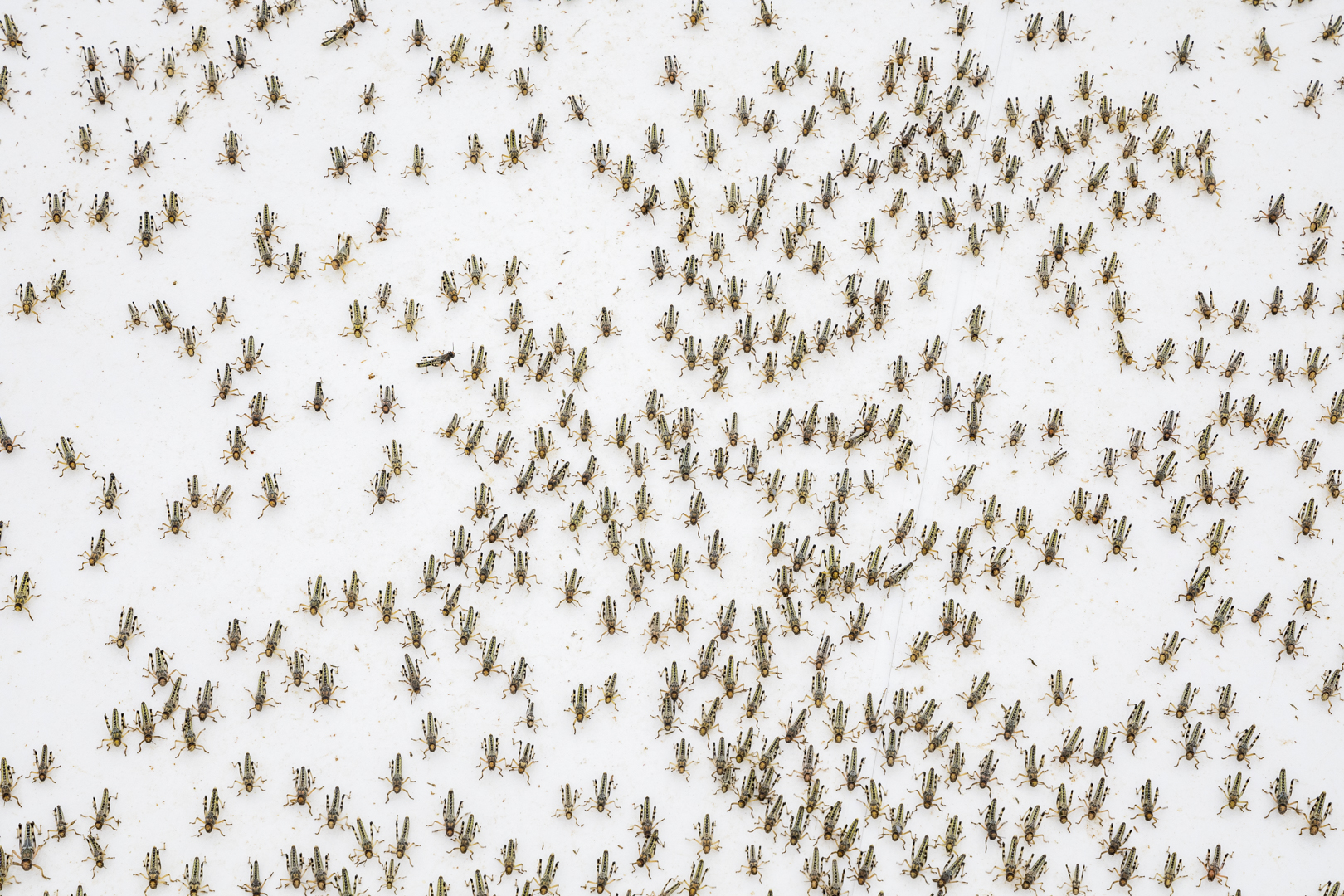 A study of juvenile desert locusts in the laboratory at the University of Konstanz. Photo: Christian Ziegler.
‘Minimalist statistical physics models have been useful in bringing the field to a position where reframing is now possible, as a result of extraordinary advances in behavioural analysis, neuroscience and virtual reality’, write Australian behavioural researcher Camille Buhl and entomologist Stephen Simpson in an accompanying perspective in Science. ‘In the quest to understand the power of the collective, access to the cognitive realm of animals is within reach.’