


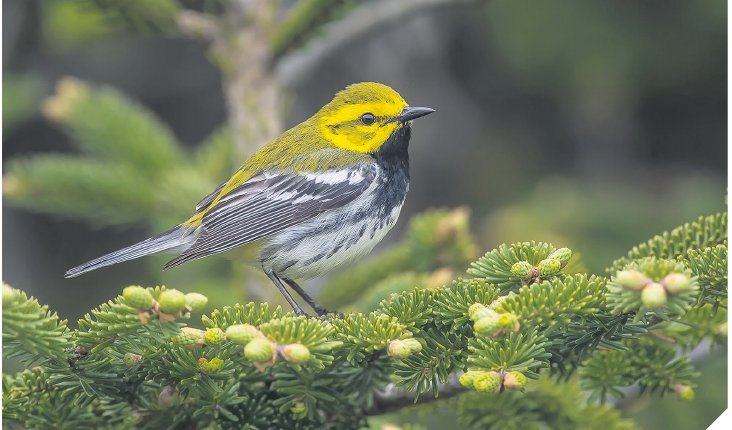
The diet of black-throated green warblers (Setophaga virens) closely resembles that of other New World warbler species, whilst their foraging behaviour differs markedly.
Where it was previously thought that songbirds partition their habitat by eating different insects, it now turns out that their diets overlap considerably.
In 1958, the renowned ecologist Robert MacArthur proposed that songbird species that closely resemble one another partition their habitat by foraging in different parts of a tree – with the different insects on their menu being the driving factor. That explanation is too simple, however, conclude American biologists on 16 April in Biology Letters, who reproduced MacArthur’s classic study using modern techniques. It is not the menu that is decisive, but body shape, size, and behaviour. To investigate this, the researchers studied thirteen species of New World warblers (Parulidae) that breed in the forests of the north-eastern United States. They combined twenty years of foraging behaviour observations with measurements of physical characteristics, and also mapped the birds’ diets through DNA analysis of their faeces.
BEHAVIOURAL DIFFERENCES
This revealed that smaller birds more frequently hang fluttering between branches, whilst larger species stay closer to the trunk. Yet almost all of them eat broadly the same insects – the biologists found DNA from more than two thousand different species in the faeces. The difference, then, lies not in what they eat, but in how they eat. The behavioural differences most likely arose through centuries of competition.
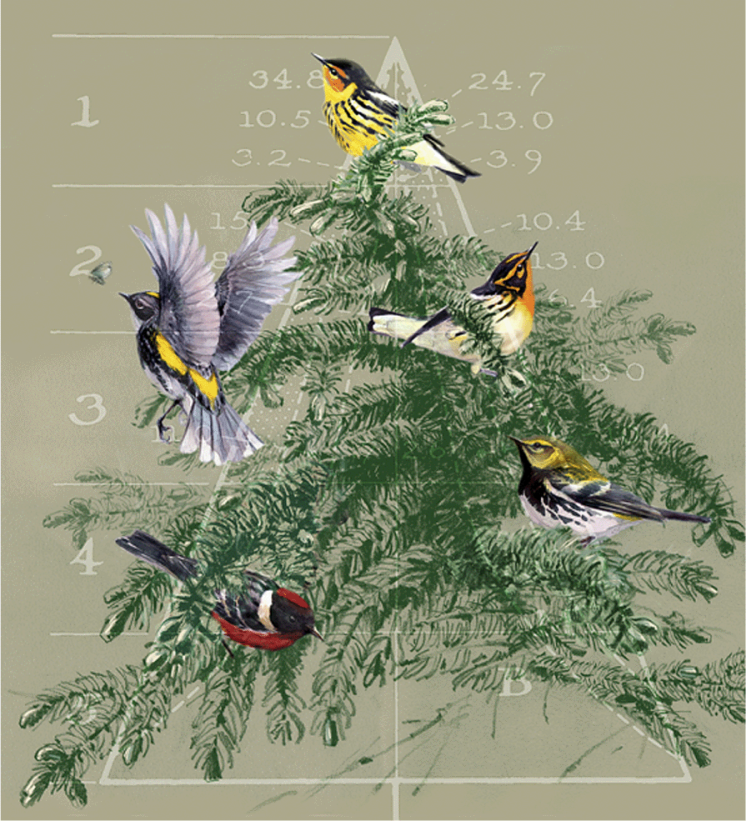
A classic figure from Robert MacArthur’s article in Ecology from 1958, illustrated with the five warblers he carefully observed for the study. Clockwise from the bottom: a bay-breasted warbler (Dendroica castanea), yellow-rumped warbler (D. coronata), Cape May warbler (D. tigrina), Blackburnian warbler (D. fusca) and black-throated green warbler (D. virens). Image: Deborah Kaspari, for the cover of the anniversary edition of ESA’s Bulletin, 2008. CC-BY-SA