


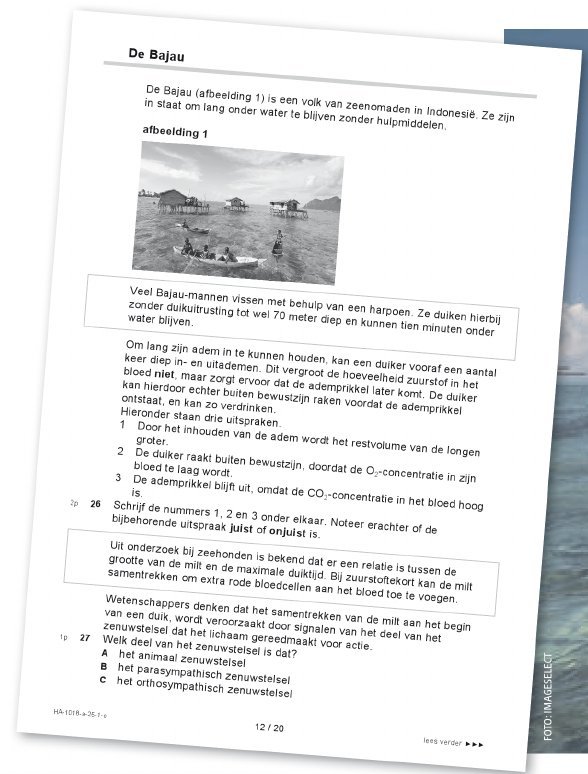
 Taking centre stage in the exam: the Bajau people, who have evolved to dive longer and deeper underwater. Photo: ImageSelect
Now that the A-level biology exams are over for many pupils, it is the teachers’ turn. What were their thoughts on the HAVO biology exam?
On Wednesday 14 May, 21,699 HAVO pupils sat the central written final examination in biology. What impression did teachers have of this year’s exam? Bionieuws asked a number of regional chairs.
‘I thought it was a straightforward exam – there were few if any questions that genuinely required pupils to make connections at the expected level. A pity there was no calculation question. I did find the contexts engaging and nicely varied. One context I particularly enjoyed was the one about the Bajau people, who live on the water and have evolved to dive longer and deeper underwater. That really gets my biology heart racing.
‘Pupils themselves also found it manageable. I can see that on some questions they have the right idea but lose marks through incomplete answers. The mark scheme is occasionally very strict as well. One example is the question about mucus-producing cells, mucus, and ciliated cells. Many pupils forget to state explicitly that the function of mucus-producing cells is that they produce mucus. Sometimes their answers show perfectly well that they understand the concept, but because of the (overly) strict mark scheme I still have to mark it wrong.
‘I thought the question about whether the increase in the number of breeding pairs of white-tailed eagles in the Netherlands is exponential was rather unfair. The graph clearly shows exponential growth overall, but not in precisely the section the question refers to. We as regional chairs lodged an objection to this, but unfortunately it was rejected by the exam office.’
‘This year the exam contained a well-balanced mix of ecology, genetics and evolution, physiology, cells, and molecular biology. The number of closed questions has increased somewhat in recent years, though that does not alter the fact that several reasoning steps are still required to arrive at a correct answer.
‘The level of difficulty seems to me appropriate for HAVO, with a good alternation between recall, application, and insight questions. The exam places emphasis on understanding biological concepts and processes rather than factual knowledge alone. Making good use of Binas or ScienceData was moreover a requirement for a number of questions.
‘The most challenging question for pupils was, I think, question 32. The context is a group of men from a culture unfamiliar to us: the Bajau people. Thanks to an enlarged spleen, these men are better able to dive. The spleen features less prominently in the curriculum than other organs, such as the heart and blood vessels or the digestive organs. Against that background, pupils have to select two groups of people to determine whether a trait is hereditary or not. The mark scheme is very unambiguous and leaves no room for alternative answers. That is perfectly fine, of course, but if as a pupil you are not on the right track, it is a difficult question.’

‘At first glance the exam seemed to me a little on the easy side. When you look at the overall final outcome, there are actually quite a few difficult questions for pupils – especially when it comes to scoring all the marks. The mark scheme is fairly tightly drawn. That is a helpful guide for teachers when marking, but pupils do not always phrase their answers with that degree of precision. For instance, when explaining commensalism, they are required to state explicitly that the white-tailed eagle benefits from nesting in a black poplar and that the black poplar experiences neither benefit nor disadvantage from this.
‘There were also some straightforward recall questions, where you could often find the answer directly in Binas or ScienceData. During the departmental discussion it was also noted that pupils who have studied hard score well; they pick up these kinds of marks regardless. On the other hand, for question 39, pupils have to work out which base was changed to convert the codon for leucine into the codon for histidine. I find that quite demanding for an A-level pupil, for just a one-mark multiple-choice question.’
‘The question about the Bajau people requires pupils to take a genuinely enquiring approach and think about which groups they should compare in an experiment. A very nice question in itself, but pupils clearly found it very difficult. I thought the rest of the exam was pleasingly varied. It is impressive how CITO manages to cover (almost) all the material with just a handful of main topics. I did not really feel anything was missing – after all, you cannot ask about everything.’
‘I thought it was a good exam: the length was fine and it aligned well with what pupils have learned. Nevertheless, there were a few things that caught my attention, particularly the fact that pupils using ScienceData were at an advantage over those using Binas. That really should not be the case. In question 12, for example, the required illustration of blood cells was included in ScienceData but not in Binas. And in question 31, the illustration in ScienceData was far clearer. That is unfair, especially when you consider that most schools use Binas.’
‘I also noticed that the mark scheme was sometimes strict. For explanation questions or “illustrate with an example” questions, pupils had to phrase their answers very precisely, otherwise they lost marks. That is frustrating, particularly when you know a pupil understands the concept but has not quite expressed it in the right way.’
‘In addition, there was a question about a mutation in a codon, even though that topic falls under school-based examination content according to the syllabus. This causes confusion: do you teach it or not? Finally, I noticed that all the names in the questions – Han, Kees, Jasper and Eileen – are very white and very Dutch. In this day and age, we could afford to think a little more inclusively. Pupils should be able to see themselves reflected in an exam. All in all, it was a solid exam, but with room for improvement on a few points.’
See also:
–Exam joy – column in Bionieuws, 30 May 2025