


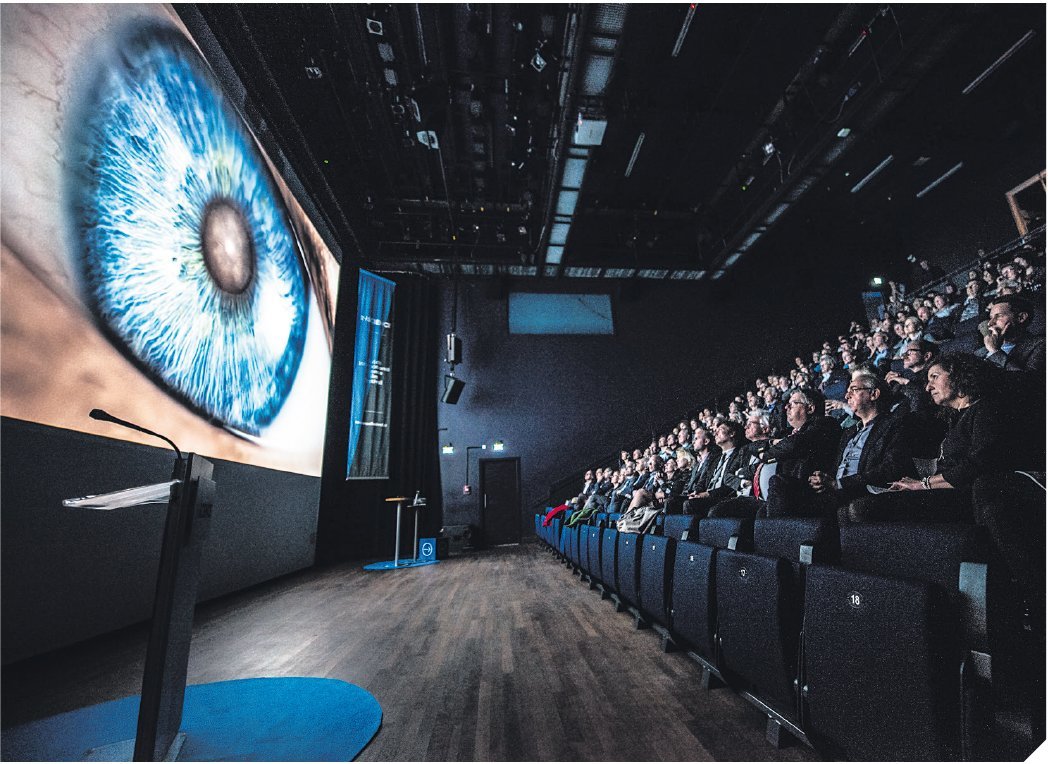
InScience offers not only screenings of science films, as here during the annual festival. Schools can book separate school screenings year-round. Photo: InScience
The science film festival InScience is almost upon us, but schools can enjoy InScience throughout the year.
Alive Inside, Bugs, Chasing Coral, Jane, Queen without Land. Just a few examples from InScience’s ‘educational film database’. InScience does not only screen science films during the annual festival – this year running from 11–16 March, see box. Schools can also book separate screenings throughout the year.
‘Teachers can find inspiration in the database, but they can also tell us what pupils are working on at school, and then we look for something to match. InScience has now been running for ten years, so quite a range of topics has been covered’, says Susanne Beckers, education programmer at InScience. There is more than enough material available for biology lessons too. ‘A nice new film, for example, is Cactus Hotel. The main character is a cactus that all kinds of animals make use of. For that I would look for a speaker who does research into ecosystems’, says Beckers. As with the festival, a school film screening comes with a supporting programme: a scientist, doctor or filmmaker takes the floor after the film to explore the subject in greater depth. Using InScience’s general lesson programme, teachers can prepare their pupils for the screening and discuss it with them afterwards.
Bespoke teaching materials are also among the possibilities. ‘These always include an element of film education and something about the content of the film’, explains Beckers. ‘Film education addresses questions such as: how was the film made, and why were those choices made? What effect does that have on your experience? We think it is important to develop that media literacy. A film is always, in a sense, manipulating you. Documentaries may seem objective, but filmmakers have always made choices, and it is important to be aware of that. For the content side, you might think, for example, of a study in the school canteen to accompany That Sugar Film.’ In this film, actor Damon Gameau follows a diet of forty teaspoons of sugar a day for sixty days. For the accompanying assignment, pupils try to put together a sugar-free meal using food from the canteen. They then design a small study of their own.
Curriculum
‘We have been using these teaching materials for a few years now, because a school keeps coming back for them. For speakers at the screening, we have had diabetes specialists and nutritionists, for example’, says Beckers. ‘This school was already working on nutrition when they approached us. That is what I like best – when the screening is embedded in the curriculum. It should not just be a day out. A school screening can be a great way to launch a theme, or to provide deeper understanding. I think it is important that pupils understand why they are sitting in the cinema and what the connection is with what they are doing at school.’
Beckers does consider coming to the cinema a must: ‘First of all because we have control over the screening here and can therefore create the right experience in terms of light and sound. But it is also good for pupils to get out of the classroom for a while. In exceptional cases, such as during the Covid pandemic, it can also take place at school, with a scientist joining via Zoom. A real encounter is of course much more enjoyable. That is another nice thing: pupils here have a genuine encounter with a scientist, and discover that this is not necessarily someone in a white coat in a laboratory. We also try to pay attention to diversity when looking for speakers.’ Because of the school screenings at LUX cinema in Nijmegen, InScience works primarily with schools from the surrounding area, though screenings at other cinemas are sometimes possible too.
‘Documentaries may seem objective, but filmmakers have always made choices’
In addition to school screenings, InScience can also offer workshops. ‘We work with Pax Christi College in Druten on a practical assignment for biology and geography. For this assignment, pupils make short nature documentaries. We help to make these mini-documentaries artistic, with a workshop on camera use, filters and editing. If you are making a film about bees, for instance, it can be fun to move the camera around as a bee would, or to use a filter showing how bees see the world’, says Beckers. Although the festival is almost here, it has in principle little to do with InScience’s school screenings. ‘During the festival it is sometimes a little easier to involve filmmakers. Last year, for example, the maker of My Garden of a Thousand Bees was present. You can then combine that nicely with a school screening. But we really do offer this year-round’, says Beckers.