


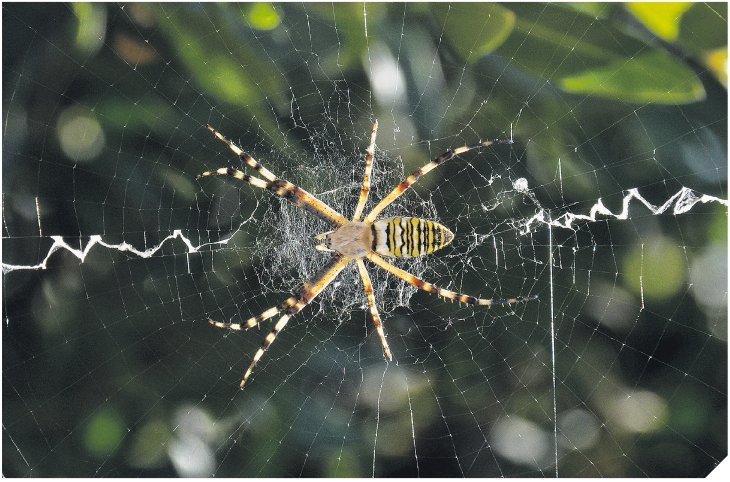
The zigzagging stabilimenta in the web of this wasp spider aid in prey detection. PHOTO: PIERLUIGI RIZZO
Special structures in orb webs help wasp spiders locate prey caught in their web.
The zigzagging threads sometimes found in spider webs help spiders detect prey caught in their web. That is the conclusion of an international team of researchers, publishing on 29 October in Plos One, based on computer simulations.
The zigzag threads are also known as stabilimenta, and occur in a variety of forms. This emerges from field research in Sardinia, where researchers examined the webs of wasp spiders (Argiope bruennichi). The thick threads often weave back and forth between the ‘spokes’ of the orb web in one way or another, but they can also form a kind of circle around the centre of the web.
By applying calculations to all these forms in simulations, the researchers determined how stabilimenta influence vibrations. When prey landing in the web generates vibrations at an angle perpendicular to the threads that spiral outward from the centre of the web, the presence of a stabilimentum makes little difference. However, when vibrations travel in the same direction as those outward-spiralling threads, they propagate further through a web containing a stabilimentum. As a result, the vibrations reach more points on the web, where a spider can then detect them.